Introduction: A Purpose-Built Storage Solution for Long Loads
Warehouses, factories, construction sites, steel service centers, timber yards, building-material suppliers, and industrial distribution facilities often handle products that cannot be stored efficiently on conventional pallet racks. Pipes, lumber, steel bars, metal profiles, carpets, rolls of fabric, plastic sheets, tubes, and other elongated materials may be too long, too flexible, too bulky, or too irregularly shaped for standard shelving systems. When these goods are placed on the floor, valuable warehouse space is lost, products become difficult to identify, and loading and unloading operations become slower and less safe.
A heavy-duty industrial cantilever shelf rack provides a dedicated solution for these challenges. Unlike traditional pallet racking, which relies on front and rear beams to support standardized pallets, cantilever racking uses vertical columns and projecting arms to create open storage levels. This configuration allows long products to be loaded from the front or side without the obstruction of front rack beams. It also provides the flexibility required for products with different lengths, diameters, weights, and shapes.
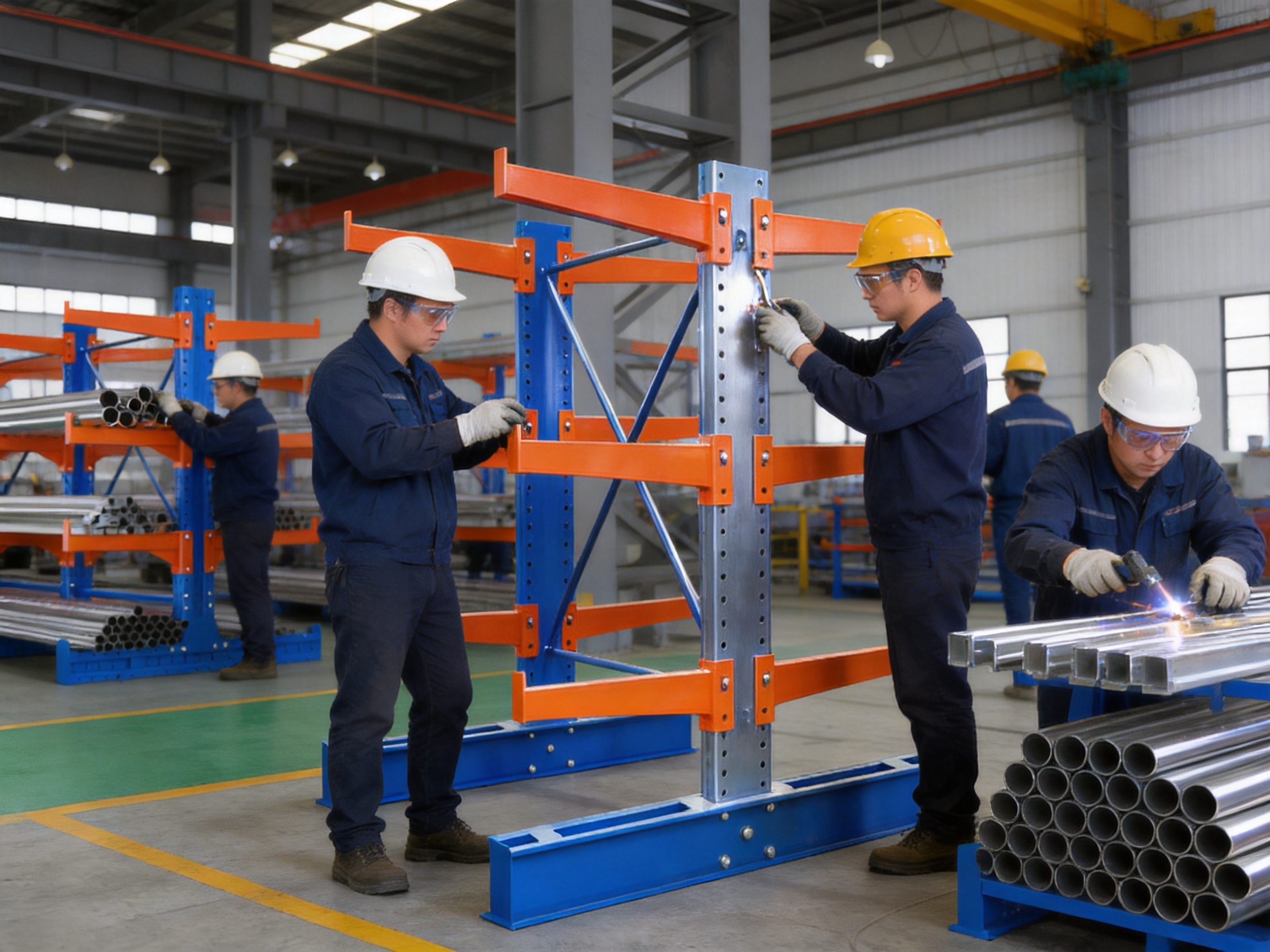
The Heavy-duty Industrial Warehouse Storage Cantilever Shelf Rack is designed around these practical requirements. Its reinforced steel construction, open-access configuration, modular design, adjustable storage levels, and durable powder-coated finish make it suitable for demanding industrial environments. The rack can be configured for light-, medium-, or heavy-duty applications and may also be equipped with optional shelves for smaller products or low-height goods.
More than a simple storage frame, this cantilever rack is part of a complete storage strategy. It helps businesses use vertical space, reduce floor congestion, simplify product access, improve stock visibility, and create a safer and more organized material-handling environment. Supported by the manufacturing capabilities of Shanghai King Global Shelf Co., Ltd., the system can be developed as a standard product or customized through OEM and ODM services.
What Is a Cantilever Rack?
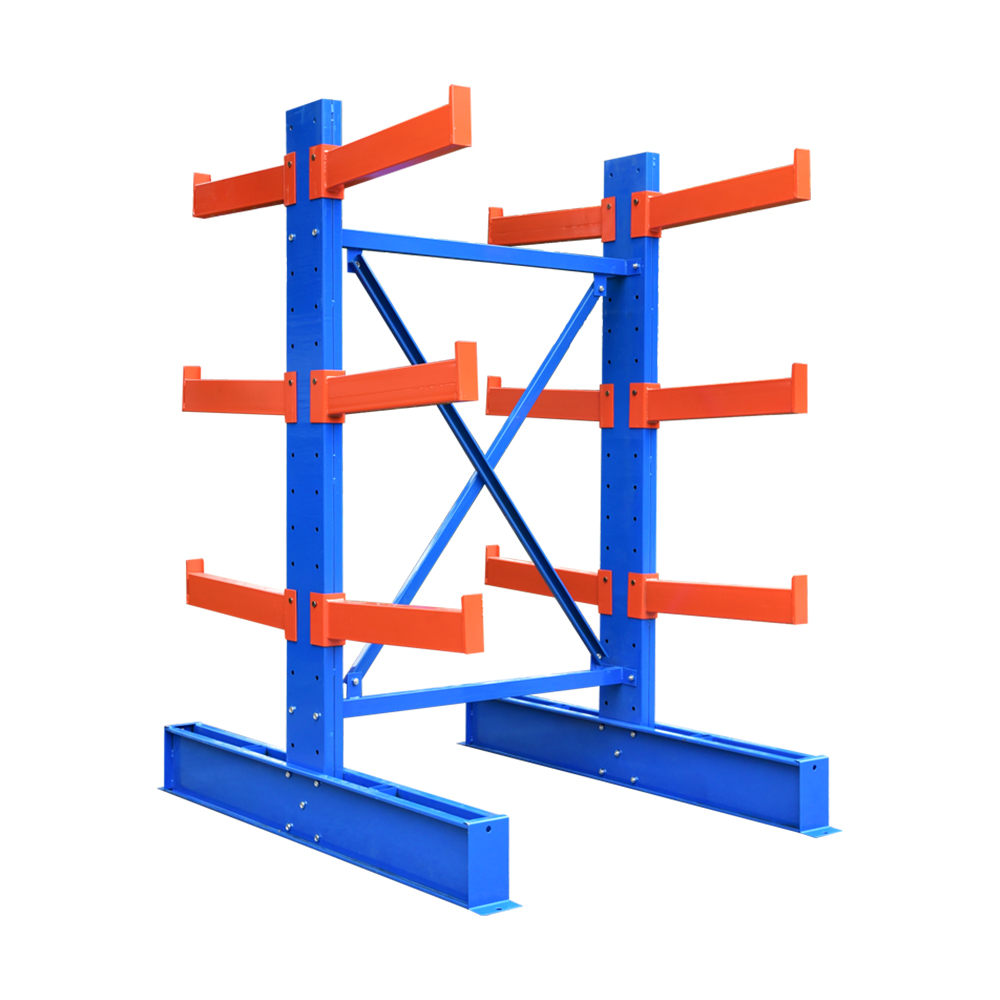
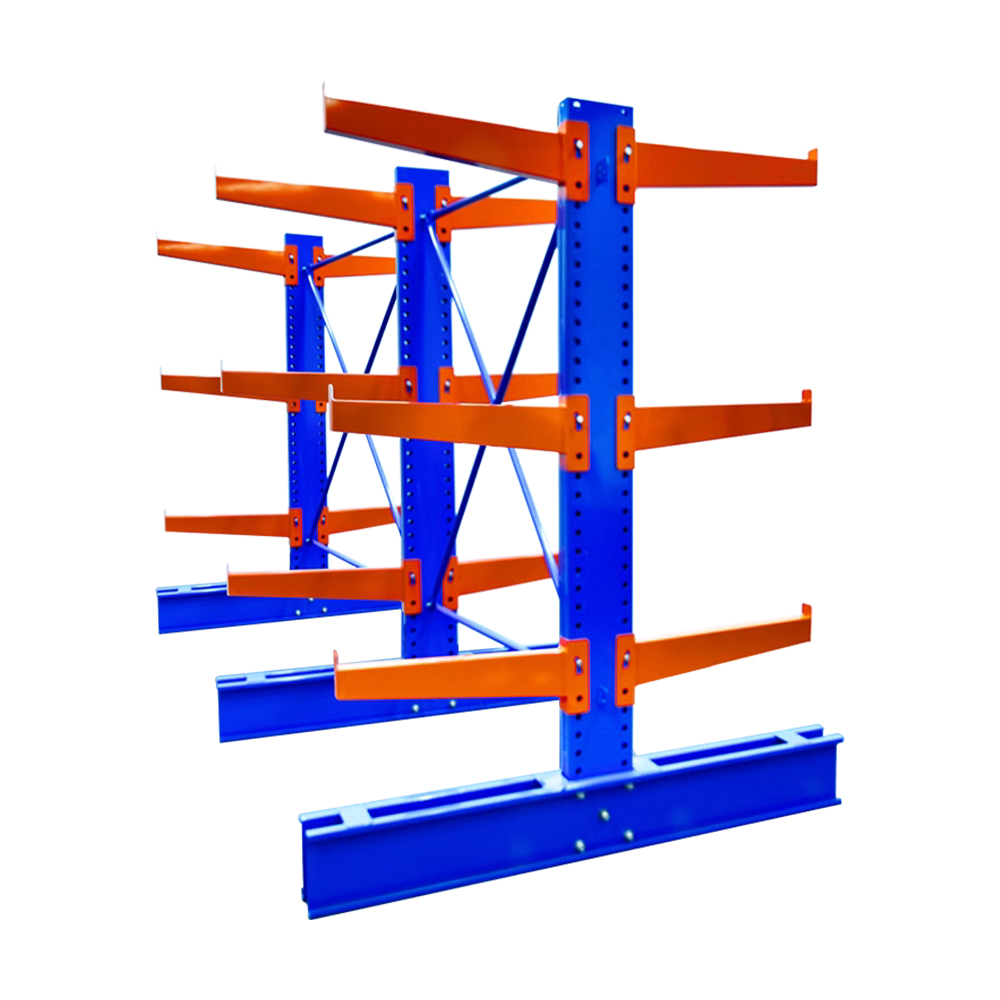
A cantilever rack is a specialized storage structure designed for long, bulky, oversized, or irregularly shaped products. Its main components generally include vertical columns, horizontal or base supports, cantilever arms, bracing, connection hardware, and protective finishes. The arms extend outward from the columns, forming open storage levels on one or both sides of the upright structure.
The open front is the defining feature of the system. Because there are no conventional front beams blocking the storage face, operators can position goods directly onto the arms using forklifts, cranes, pallet jacks, or manual handling methods, depending on the load size and rack configuration. This open design is especially valuable when the stored items are longer than a standard pallet or cannot be safely placed inside a closed shelf bay.
Cantilever racks may be configured as single-sided units for placement against a wall or double-sided units for access from both sides. The number of storage levels, column spacing, arm length, arm capacity, overall height, and base dimensions can be selected according to the facility layout and product specifications. This makes the system suitable for everything from compact workshop storage to large-scale industrial warehousing.
The design is also highly adaptable. Different arm positions can accommodate goods of different diameters and heights. Optional decking or shelves can transform selected levels into more conventional storage surfaces for boxes, accessories, fittings, and smaller items. The result is a versatile system that can store both long materials and related inventory in a single organized area.
Core Product Advantages
Dedicated Storage for Long and Irregular Goods
The primary advantage of this rack is its ability to store products that are poorly suited to conventional shelving. Long steel bars, timber, pipes, tubes, carpets, aluminum profiles, rolls of material, furniture components, and construction products can be arranged horizontally across the arms. The structure supports these products along their length, helping reduce unnecessary bending, contact with the floor, and disorganized stacking.
Conventional pallet racks are highly effective for palletized cartons and uniform loads, but their beam arrangement may make it difficult to store long products. Floor stacking can create unstable piles, make individual items hard to retrieve, and increase the risk of damage when employees move products around the storage area. A cantilever system separates product groups into accessible levels, making inventory easier to count, inspect, and retrieve.
Open and Accessible Loading Design
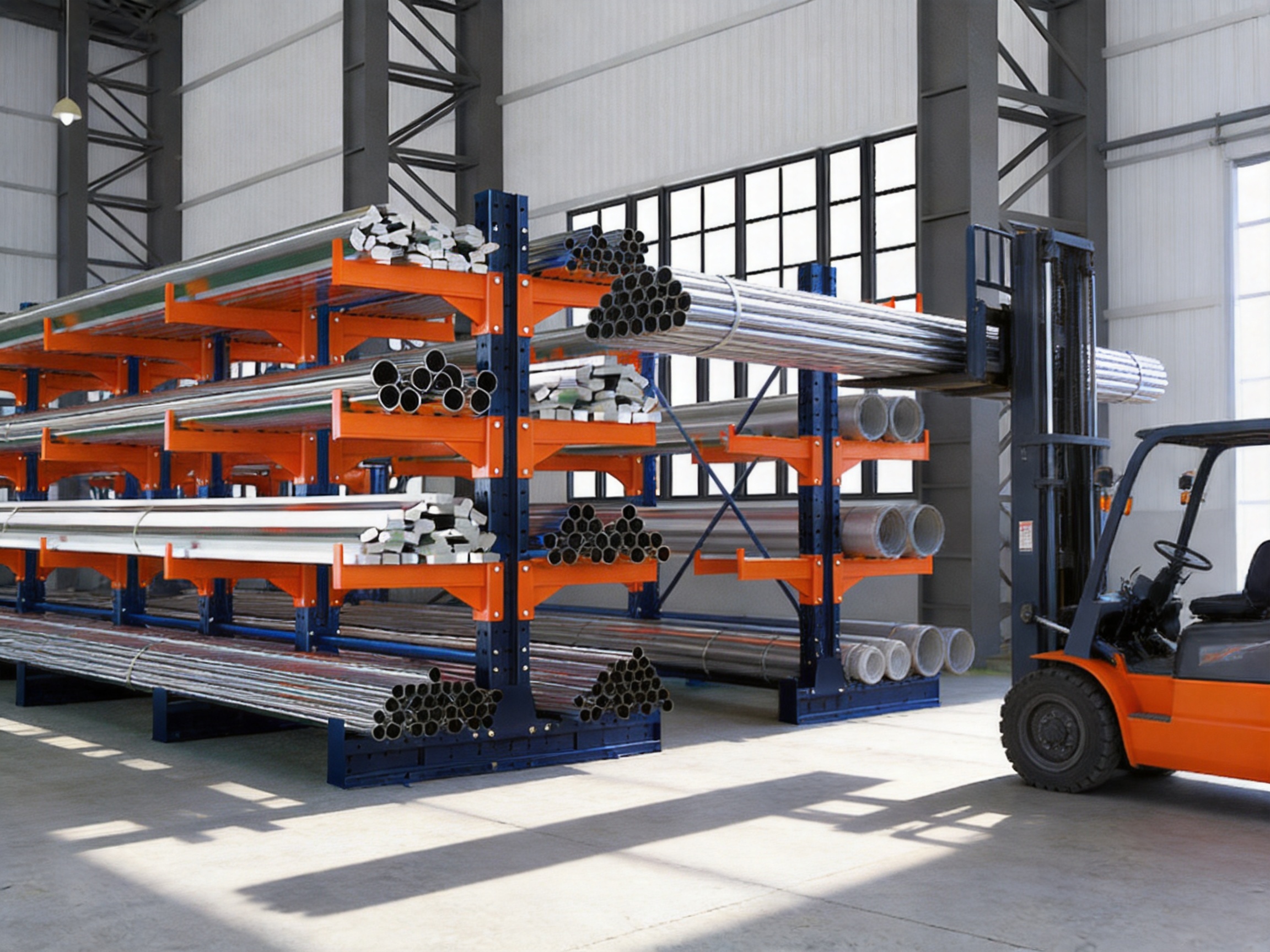
The open configuration allows operators to approach the storage levels from the front without navigating around obstructing front beams. This is a major operational advantage when handling long loads with forklifts, cranes, pallet jacks, or similar equipment. The equipment operator has a clearer view of the load and the target position, while warehouse personnel can guide the material into place more efficiently.
Wide-load access is particularly important when the material extends beyond the width of a normal pallet. A forklift can approach the rack with a long bundle, align it with the selected arms, and place it directly into storage. For crane-assisted operations, the unobstructed face also simplifies positioning and removal. The result is less handling time and fewer unnecessary movements inside the warehouse.
Accessibility also supports faster order fulfillment. When each product group has a designated location, employees can identify the correct material quickly instead of searching through floor-stacked bundles. This can improve picking accuracy, reduce congestion in aisles, and support more consistent inventory control.
Strong Load-Bearing Steel Construction
The rack is manufactured from heavy-duty steel selected for structural strength and long-term industrial use. Reinforced columns, arms, bracing members, and base supports work together to distribute loads through the frame and into the floor. The design is intended to maintain stability when storing substantial quantities of long and heavy material.
Structural performance depends on more than the thickness of a single component. The complete rack must coordinate the upright geometry, arm connections, base arrangement, bracing system, fasteners, and load distribution. A properly designed cantilever system transfers the load from the stored product to the arms, from the arms to the columns, and from the columns through the base and anchors to the supporting floor.
This integrated construction provides a reliable alternative to improvised floor storage or locally fabricated frames that may lack consistent engineering control. When the system is correctly specified, installed, loaded, and maintained, it provides a stable storage platform for demanding industrial applications.
Flexible Modular Configuration
Industrial storage requirements vary considerably from one customer to another. A timber distributor may need long arms and moderate spacing, while a steel service center may require shorter arm projections but substantially higher load capacity. A carpet warehouse may prioritize roll diameter and smooth product access, while a building-material supplier may need multiple levels for pipes, profiles, and packaged accessories.
The modular structure of the cantilever rack makes it possible to adapt the system to these different requirements. Customers can select the overall length, height, width, arm projection, number of levels, and upright spacing according to the available space and stored products. Additional bays can also be incorporated as inventory volume grows, subject to appropriate engineering review and floor conditions.
Adjustable arm positions allow the vertical clearance between levels to be changed. This is valuable when product dimensions are not uniform. Lower levels can be arranged for heavy or large-diameter loads, while higher levels can store lighter or smaller items. The ability to modify the configuration helps businesses avoid paying for unnecessary capacity and supports future changes in product mix.
Optional Shelves for Mixed Inventory
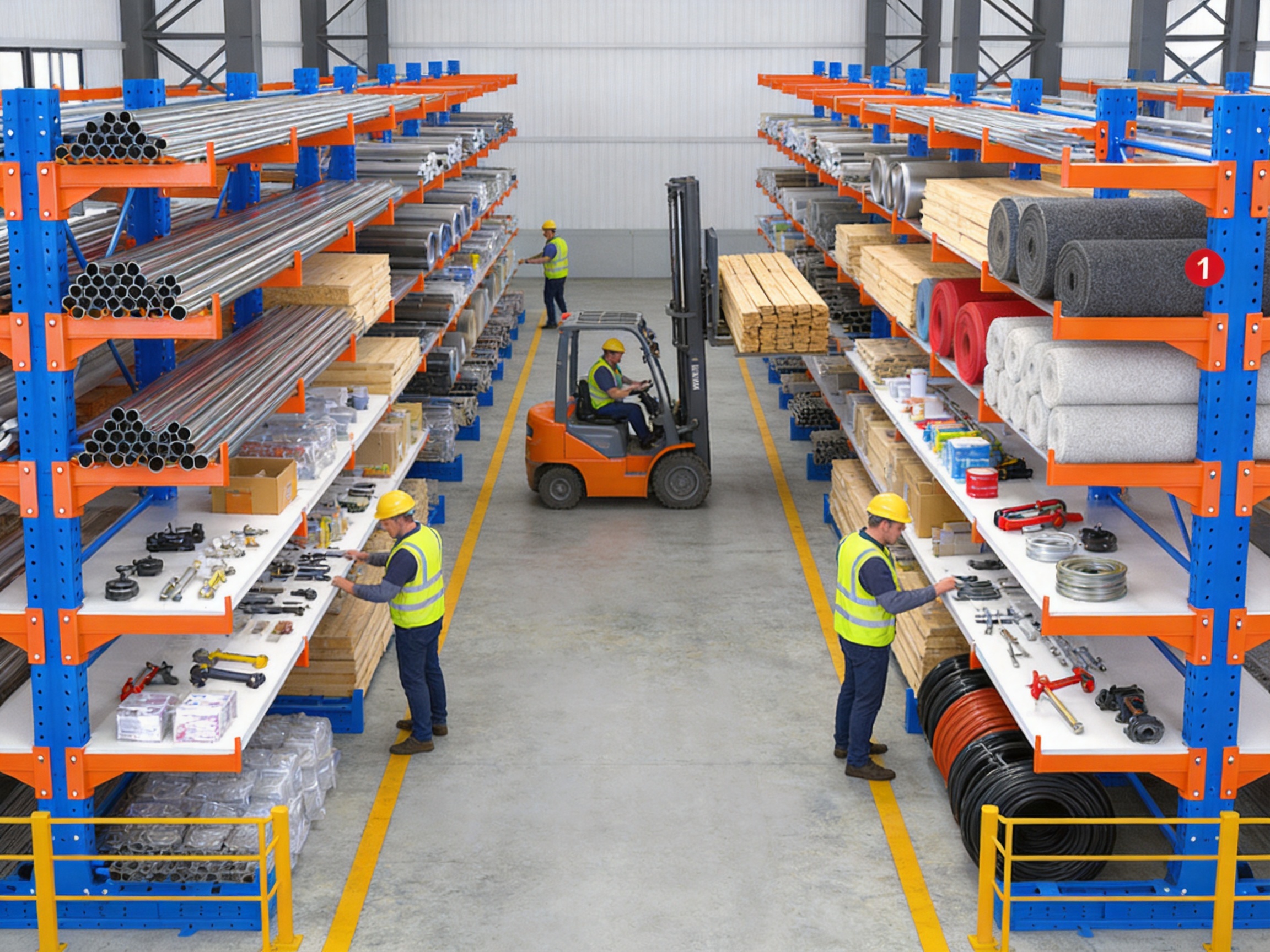
Although cantilever racks are primarily intended for long materials, optional shelves can increase their usefulness. Shelves may be installed for small parts, low-height products, fittings, fasteners, packaging materials, tools, or accessories associated with the main inventory. This creates a combined storage station for both primary goods and related items.
For example, a pipe distributor could store long pipe bundles on the cantilever arms and place couplings, valves, clamps, and packaging supplies on optional shelf surfaces. A timber supplier could store boards on the arms while using shelf levels for hardware and treatment products. This mixed-storage capability can reduce the need for separate shelving systems and improve the efficiency of the storage area.
Durable Powder-Coated Finish
The rack is treated with a powder coating finish designed to resist rust, corrosion, and surface scratches. The finish provides a protective layer over the steel and contributes to a clean, professional appearance in warehouses, factories, workshops, and construction-related facilities.
Industrial storage systems are exposed to frequent contact with handling equipment, changing temperatures, dust, moisture, and repeated loading activity. A durable finish helps preserve the rack surface under normal operating conditions. It also makes the system easier to maintain because dust and ordinary dirt can generally be removed from a smooth coated surface more easily than from a rough or poorly treated frame.
While the finish contributes to durability, it should not be considered a substitute for correct environmental selection and maintenance. Facilities with unusual chemical exposure, persistent outdoor moisture, coastal conditions, or specialized hygiene requirements should discuss suitable coating and material options with the manufacturer. Proper floor drainage, load control, inspections, and prompt repair of impact damage remain important for long-term performance.
Heavy-duty Industrial Warehouse Storage Cantilever Shelf Rack
Advantages Compared with Conventional Storage Methods
Better Use of Vertical Space
Floor storage is often the default method for long products, but it uses warehouse space inefficiently. Materials placed directly on the floor occupy a large footprint and may require wide clearance zones for access. As inventory levels increase, goods may spread into aisles or be stacked in unstable layers.
Cantilever racking uses the vertical volume of the building. Multiple storage levels can be arranged above the floor, allowing businesses to increase capacity without expanding the building footprint. This is especially useful in facilities where land and building space are expensive or where construction expansion is not immediately possible.
Vertical storage must always be planned responsibly. The rack height, stored load, aisle width, equipment reach, floor capacity, and building conditions should be reviewed before installation. When these factors are properly coordinated, the system can provide a significant improvement in space utilization.
Improved Product Visibility
Unorganized floor piles can hide products and make inventory identification difficult. Employees may need to move several bundles before finding a particular size, length, or grade. This creates delays and increases the risk of selecting the wrong item.
The open structure of a cantilever rack separates product categories into visible locations. Labels can be placed on columns, arms, or nearby signs. Products can be grouped by size, material, customer order, or turnover rate. Improved visibility supports more accurate inventory records and helps employees locate products without unnecessary handling.
Reduced Product Damage
Long materials can become scratched, bent, crushed, contaminated, or exposed to moisture when they are stored directly on the ground. They may also be damaged when workers drag them from a crowded pile. A rack provides defined support points and keeps goods above the floor.
Appropriate arm spacing is important. The supports should be positioned to provide adequate distribution along the length of the product without creating excessive overhang. Protective accessories, end stops, separators, or decking may be specified when required by the product type. These details help protect both the stored goods and the rack structure.
More Efficient Handling
Because the storage face is open, a forklift or other handling device can approach the load directly. This reduces the number of transfers between floor areas, temporary staging zones, and storage locations. Direct placement can lower labor requirements and shorten the time needed to put away or retrieve inventory.
Improved handling efficiency is especially valuable for heavy, long, or high-value goods. Each additional movement creates an opportunity for impact, dropping, or improper support. A well-planned rack layout provides a more predictable workflow from receiving to storage, picking, staging, and dispatch.
Greater Flexibility Than Fixed Closed Shelving
Closed shelving systems generally depend on fixed shelf dimensions. If products become longer, heavier, or more irregular, the existing shelves may no longer be suitable. A cantilever system offers greater adaptability because the arms and levels can be configured around the product rather than forcing the product into a standard shelf opening.
This flexibility can support changing business conditions. A manufacturer may begin with a moderate number of storage levels and later add bays or adjust arm positions. A distributor may change the balance between pipes, timber, profiles, and rolls over time. Modular racking helps the facility respond to these changes without replacing the entire storage system.
Engineering and Configuration Considerations
Load Capacity Planning
Load capacity should be determined before ordering or installing a cantilever rack. The required capacity depends on the weight of individual products, the number of products per level, the distribution of the load, the arm length, the upright spacing, and the total number of storage levels. Concentrated loads may create different structural demands from evenly distributed bundles.
Customers should provide accurate information about maximum product weight, product dimensions, bundle size, loading method, and expected storage density. The manufacturer can then recommend a suitable light-, medium-, or heavy-duty configuration. Capacity information should be clearly documented and displayed at the installation site where appropriate.
Operators should never exceed the stated capacity or place loads in a way that differs significantly from the intended design. Heavy products are generally best positioned on lower levels to improve stability and reduce the center of gravity. Load changes should be reviewed if the business begins storing materials that are substantially heavier or longer than the original specification.
Arm Length and Product Overhang
The arm projection should be selected according to the width and shape of the stored material. An arm that is too short may not provide adequate support, while an arm that is unnecessarily long may reduce capacity or increase structural demand. The goal is to provide stable support without creating excessive overhang.
Long products may extend beyond the ends of the rack, but overhang should be controlled. Excessive overhang can interfere with aisles, neighboring equipment, emergency routes, or other storage positions. End stops or retaining features may be considered where products could roll or slide from the arms.
Single-Sided and Double-Sided Layouts
Single-sided cantilever racks are suitable for installation against a wall or along the perimeter of a warehouse. They provide storage access from one side and can make efficient use of otherwise unused wall-adjacent space.
Double-sided units provide access from both sides and are commonly arranged in rows with aisles between them. This layout can increase storage density and support efficient circulation in larger warehouses. The selected arrangement should consider forklift turning radius, material length, loading direction, pedestrian movement, fire safety, and maintenance access.
Floor and Installation Requirements
A cantilever rack transfers its load to the floor through the base and anchoring system. The supporting floor must be sufficiently level, strong, and suitable for the anticipated loads. Uneven or damaged concrete may affect alignment and stability. Before installation, the facility should review floor condition, slab thickness, anchor requirements, and any local building considerations.
Installation should follow the manufacturer’s instructions and should be performed by trained personnel. Columns must be aligned, bracing must be correctly fitted, fasteners must be properly tightened, and anchors must be installed according to the specified method. Any field modification should be approved by a qualified technical representative because cutting, drilling, or changing structural components can affect performance.
Manufacturing Strengths and Quality Approach
Integrated Product Development
Shanghai King Global Shelf Co., Ltd. specializes in the development, production, and sales of shelving and storage products. An integrated business model allows product design, manufacturing, quality control, and market service to work together rather than operating as isolated activities.
For a cantilever rack, this integration is important because customer requirements often involve several connected decisions. A request for a certain arm length may affect column strength, bracing, base dimensions, coating, packaging, and installation. A manufacturer with experience across the complete product cycle can evaluate these relationships more effectively and provide a coordinated solution.
Modern Production Base and Technical Resources
The company operates a 60,000-square-meter production base and employs more than 300 people. This scale provides a foundation for organized manufacturing, production planning, material management, technical development, and quality inspection.
A modern production base can support the repeated manufacturing steps required for industrial racking, including steel preparation, forming, cutting, welding, drilling, surface treatment, coating, assembly checks, and packaging. Consistent process control is essential because racks are structural products in which small dimensional variations can affect alignment and assembly.
Production scale also helps the manufacturer serve different order types. Standard products can be produced for routine requirements, while customized systems can be developed for special dimensions, market preferences, branding requirements, and project layouts. This balance between standardization and customization is a meaningful advantage for international customers.
Professional Technical Team
The technical team plays a central role in converting warehouse requirements into a workable storage design. Engineers and product specialists can evaluate product dimensions, load conditions, storage levels, handling equipment, layout limitations, and expansion plans.
Technical support is particularly valuable when a customer is unsure which rack configuration is appropriate. Instead of selecting a product based only on appearance, the customer can provide details about the intended application and receive guidance on capacity, dimensions, accessories, and layout. This reduces the risk of purchasing a system that does not match the actual operating environment.
Quality Control Through Multiple Production Stages
Quality control should cover more than the final visual inspection. It should begin with material verification and continue through forming, welding, dimensional checking, coating, assembly, and packaging. Each stage contributes to the final reliability of the storage system.
Material inspection helps confirm that the steel and related components are suitable for the specified application. Dimensional checks help control column length, arm geometry, hole positions, and connection compatibility. Welding inspections help identify visible defects or inconsistencies. Coating checks help verify surface coverage and appearance. Final inspections help confirm that the correct components are included and protected for shipment.
A structured quality approach creates more consistent products and helps reduce installation difficulties. It also supports repeat orders because customers can expect similar dimensions and finish quality across multiple projects.
OEM and ODM Capabilities
The company supplies standard shelving and storage products as well as customized OEM and ODM solutions. OEM support may be useful for distributors, contractors, and storage-equipment brands that require products manufactured to their specifications or sold under their own market identity. ODM cooperation may be appropriate for customers seeking assistance with product development, configuration, or adaptation for a particular market.
Customization can involve rack dimensions, arm capacity, column height, coating color, accessories, packaging, labels, documentation, and project-specific layouts. For international customers, customization may also include regional preferences related to warehouse equipment, product presentation, or installation methods.
Customization should be based on engineering and production feasibility rather than cosmetic changes alone. Any modification affecting structural capacity, connection design, or stability must be reviewed carefully. The benefit of working with an experienced manufacturer is that customization can be coordinated with production capability and quality control.
Production Process for Industrial Cantilever Racking
Requirement Analysis and Product Design
The manufacturing process begins with understanding the customer’s application. Important information includes the type of goods, maximum load, product length, bundle dimensions, number of storage levels, available floor area, handling equipment, desired finish, and expected operating conditions.
Based on these requirements, the technical team can develop a suitable configuration. The design may include single-sided or double-sided columns, selected arm projections, adjustable levels, optional shelves, protective stops, and appropriate bracing. Drawings or technical documentation can then be used to confirm the structure before production.
Steel Preparation and Component Forming
Steel components are prepared according to the approved design. Depending on the component, manufacturing may include cutting, punching, drilling, bending, rolling, or other forming operations. Accurate preparation is important for ensuring that parts fit correctly during assembly.
Columns require consistent hole patterns or connection points when adjustable arms are used. Arms must maintain the specified geometry so that stored products remain properly supported. Base components must align with the column and anchoring system. Controlled forming and dimensional inspection help maintain interchangeability between parts.
Welding and Structural Assembly
Welding may be used to join bracing, base elements, reinforcement parts, or other components into subassemblies. Weld quality contributes to the overall strength and durability of the rack. Production controls should address joint preparation, welding consistency, alignment, and the removal of unacceptable defects.
Where bolted connections are used, hole location and fastener compatibility are equally important. The combination of welded subassemblies and bolted field connections can make the rack strong while allowing practical transportation and installation.
Surface Preparation and Powder Coating
Before powder coating, steel surfaces should be prepared to support adhesion and consistent coverage. Surface preparation may include cleaning, removal of contaminants, and treatment appropriate to the manufacturing process. The powder coating is then applied and cured to create a protective finish.
Proper coating contributes to resistance against ordinary industrial wear, corrosion, and scratches. It also gives the finished rack a consistent appearance across columns, arms, braces, and accessories. Customers with special environmental requirements should communicate those conditions during the design stage so that the finish can be selected appropriately.
Inspection, Packaging, and Delivery Preparation
After finishing, components can be checked for dimensions, coating condition, completeness, and conformity with the approved order. Components should be packaged to reduce the risk of scratches, bending, or impact during handling and transport.
Clear identification of columns, arms, braces, hardware, and accessories can simplify installation at the customer’s site. For larger projects, organized packing and documentation can help installers identify parts by rack section or storage zone. Good delivery preparation is especially important for export orders traveling long distances through multiple handling stages.
Applications Across Different Industries
Steel and Metal Distribution
Steel service centers and metal distributors commonly handle bars, tubes, angles, channels, sheets, and profiles in a range of lengths and weights. Cantilever racks separate these materials by specification and make them more accessible to forklifts and overhead handling equipment.
Organized storage can reduce the risk of mixing different grades or dimensions. It can also create clearer staging areas for incoming materials, customer orders, cutting operations, and outbound shipments.
Timber and Building Materials
Lumber, wood panels, molding, flooring materials, and construction profiles are often long and difficult to stack safely on the floor. Cantilever racks provide a stable storage structure while keeping the material off the ground and visible from the aisle.
Building-material suppliers may combine cantilever arms with optional shelves for brackets, fasteners, tools, adhesives, and other related products. This creates a practical storage area for both large materials and small accessories.
Pipe, Tube, and Plumbing Products
Pipes and tubes may vary significantly in diameter, length, and material. A modular cantilever system can be arranged with different level clearances to accommodate these variations. Retaining accessories or suitable arm surfaces may be considered when round products could roll.
For plumbing and industrial-piping suppliers, improved organization can help employees identify products quickly and prepare complete orders with fewer searches through mixed bundles.
Carpet, Fabric, and Roll Storage
Carpets, textiles, films, cable, hoses, and other rolled materials can occupy significant floor space. Cantilever racking can support these products horizontally, subject to the weight and diameter requirements of each roll.
Roll storage should be planned carefully to prevent unintended movement and to protect the product surface. The rack design may include suitable supports, separators, or shelves depending on the material characteristics and handling process.
Manufacturing and Maintenance Facilities
Factories often need to store raw materials, work-in-progress components, replacement parts, and finished products. A cantilever rack can be placed near production areas to reduce travel time between storage and processing equipment.
Maintenance departments can also use optional shelves for tools, spare parts, pipes, electrical conduit, and repair materials. A well-organized maintenance storage area can improve response time and help control stock levels.
Safety, Operation, and Maintenance
Safe Loading Practices
Operators should load products evenly and avoid sudden impact against the arms or columns. Long materials should be positioned so that their weight is appropriately distributed across the intended supports. Products should not be dragged across the rack in a way that could damage the coating or deform the arms.
Loads should remain within the specified capacity, and heavier materials should generally be stored on lower levels. Aisles should remain clear so that handling equipment can approach the rack safely. Employees should receive training on the correct loading method and on the risks associated with unstable, rolling, or excessively overhanging products.
Equipment Coordination
The rack layout should match the capabilities of the forklifts, cranes, pallet jacks, or other equipment used at the facility. Operators need sufficient aisle width, visibility, lifting height, and turning space. The length of the stored goods should also be considered when planning vehicle movement.
Where pedestrians and handling equipment share the same area, traffic controls, marked walkways, warning signs, and operating procedures can help reduce the risk of collisions. The rack should not obstruct emergency exits, fire equipment, lighting, ventilation, or building services.
Routine Inspections
Regular inspections help identify damage before it becomes a more serious problem. Personnel should look for bent arms, deformed columns, loose fasteners, damaged braces, anchor movement, coating failure, corrosion, or impact marks from forklifts.
Any component that appears structurally compromised should be unloaded and evaluated by a qualified person. Repairs or replacements should use approved parts and methods. Unauthorized welding, drilling, cutting, or straightening can weaken the structure and should be avoided.
Housekeeping and Load Identification
Good housekeeping supports both safety and efficiency. The floor around the rack should be kept free of loose packaging, debris, oil, and obstacles. Storage locations should be labeled clearly, and products should be arranged according to an established inventory system.
Capacity signs, rack identification labels, and product-category markers can help employees operate the system consistently. A clear visual management system is particularly valuable in facilities with many product sizes or frequent staff changes.
Comparison of Storage Options
| Storage Method | Best Suited For | Access Characteristics | Space Efficiency | Limitations |
|---|
| Heavy-duty cantilever racking | Long, bulky, irregular, or oversized materials | Open front access for forklifts, cranes, and manual handling | Uses vertical space and supports organized long-load storage | Requires suitable floor conditions, capacity planning, and safe loading procedures |
| Conventional pallet racking | Standard pallets, cartons, and uniform unit loads | Efficient for palletized goods with compatible handling equipment | Very effective for standardized pallet inventory | Less convenient for long products and irregular bundles |
| Floor stacking | Temporary storage or low-volume materials | Simple initial access but often requires moving other products | Consumes floor area and may reduce aisle availability | Lower visibility, possible instability, and greater product-handling difficulty |
| Closed shelving | Small parts, cartons, tools, and packaged goods | Convenient for smaller products within fixed shelf dimensions | Good for compact inventory but limited by shelf size | Not ideal for long, heavy, or oversized materials |
| Custom floor frames | Special applications with limited standard requirements | Depends on the individual design | May use space effectively if professionally engineered | Quality, capacity, and future expandability may vary significantly |
Why Manufacturer Experience Matters
Selecting a cantilever rack is not only a matter of choosing a visual design. The system must match the products, equipment, building, workflow, and future storage requirements. An experienced manufacturer can help identify the technical details that may be overlooked during a simple product purchase.
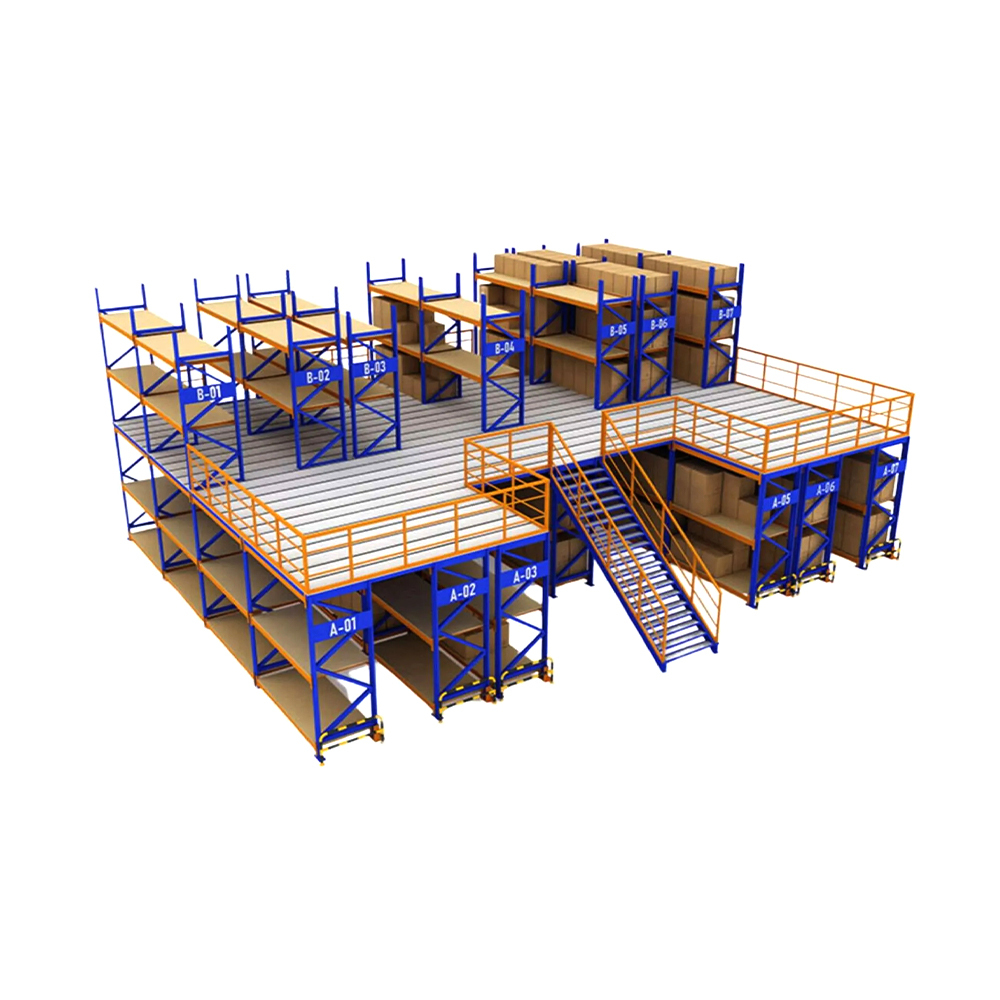
Shanghai King Global Shelf Co., Ltd. has supplied shelving and storage solutions for supermarkets, warehouses, offices, homes, and industrial applications since its establishment in 2010. Its product range includes warehouse racks, pallet racking, mezzanine racking, cantilever racks, supermarket shelving, and office and home storage products.
This broad product experience allows the company to understand how different storage systems work together. A warehouse project may require cantilever racks for long products, pallet racking for boxed inventory, shelving for small parts, and mezzanine storage for additional floor space. A supplier capable of coordinating multiple product categories can provide a more consistent overall solution.
The company exports products to North America, Southeast Asia, Japan, South Korea, the Middle East, Europe, and other regions. International experience can support communication across different markets, project expectations, packaging requirements, and customer service practices.
Its stated focus is to provide strong, efficient, and customized racking solutions that improve space utilization, operating efficiency, and storage safety. These priorities are directly aligned with the practical benefits expected from a well-designed cantilever rack.
Purchasing and Project Planning Guide
Define the Stored Products
Begin by listing the materials that will be stored. Record their maximum and minimum lengths, widths, diameters, weights, surface characteristics, flexibility, and packaging method. Indicate whether products are loose, bundled, wrapped, boxed, or placed on supports.
Record Handling Equipment
Identify the equipment used for loading and unloading. Forklift type, fork length, lifting height, turning radius, crane capacity, and pallet-jack dimensions may influence rack spacing and aisle layout. If equipment will change in the future, that possibility should be included in the planning discussion.
Determine Capacity and Expansion Needs
Estimate the maximum load per arm, per level, and per rack bay. Consider both current inventory and expected growth. A modular system can often be designed with future expansion in mind, but the original columns, layout, and floor conditions must be suitable for the planned development.
Review the Installation Environment
Provide information about the building, including available height, floor condition, access doors, columns, walls, lighting, fire-protection equipment, and restricted areas. Outdoor or semi-outdoor installations should be evaluated separately because moisture, wind, temperature changes, and corrosion exposure may require additional measures.
Confirm Technical Documentation
Before production, customers should review drawings, dimensions, capacity information, finish requirements, accessories, packaging, and installation expectations. Clear technical confirmation helps prevent misunderstandings and ensures that the manufactured rack matches the intended application.
Frequently Asked Questions
What products can be stored on a cantilever rack?
Cantilever racks are suitable for long or irregular products such as pipes, timber, steel bars, metal profiles, carpets, fabric rolls, tubes, hoses, cables, plastic materials, furniture components, and construction products. The final suitability depends on product weight, dimensions, shape, and handling method.
Can the rack be used for heavy steel products?
Yes, the rack can be configured for heavy-duty applications, but the required capacity must be calculated from the actual product weights, arm length, storage levels, upright spacing, and load distribution. Heavy steel products should not be placed on a standard configuration without technical confirmation.
Can a cantilever rack be installed against a wall?
Yes. A single-sided configuration is commonly used against a wall or along the edge of a storage area. A double-sided configuration can be used where access is required from both sides.
Are the storage arms adjustable?
The modular design can provide adjustable storage levels, allowing the vertical spacing between arms to be changed to suit different product sizes. The adjustment method and available positions should be confirmed in the technical specification for the selected model.
Can the rack include shelves?
Optional shelves may be added for smaller or low-height goods, including fittings, tools, boxes, accessories, and related inventory. This feature can create mixed storage for both long materials and small products.
Is the rack suitable for forklifts and cranes?
The open design is intended to support access by wide-load handling equipment such as forklifts, pallet jacks, and cranes. The layout must provide sufficient clearance, and operators must follow safe handling procedures appropriate to the equipment and stored load.
How does powder coating protect the rack?
Powder coating creates a protective surface that helps resist ordinary rust, corrosion, scratches, and industrial wear. It also improves appearance and simplifies routine cleaning. Special environments may require additional coating or material recommendations.
Can the rack be customized?
Yes. Customization may include length, height, width, arm projection, capacity, storage levels, finish, accessories, packaging, and project-specific configurations. Structural changes should be reviewed by the manufacturer’s technical team before production.
What information should be provided for a quotation?
Useful information includes product type, maximum load, product length and dimensions, number of levels, required rack quantity, available space, handling equipment, single- or double-sided preference, finish requirements, destination, and whether shelves or other accessories are needed.
How should the rack be maintained?
Inspect the columns, arms, braces, fasteners, anchors, and coating regularly. Keep aisles clear, avoid overloading, repair impact damage promptly, and replace damaged components with approved parts. Any serious structural damage should be evaluated by a qualified professional before the rack is returned to service.
Conclusion
The Heavy-duty Industrial Warehouse Storage Cantilever Shelf Rack is a practical and adaptable solution for companies that handle long, bulky, heavy, or irregularly shaped goods. Its open design provides direct access for forklifts, pallet jacks, cranes, and manual handling operations. Its reinforced steel construction supports demanding industrial use, while its modular configuration allows the storage levels, dimensions, capacity, and accessories to be matched to specific products.
Compared with floor stacking, the system improves vertical space utilization, product visibility, inventory organization, and handling efficiency. Compared with conventional pallet racking or closed shelving, it offers greater flexibility for materials that do not fit standard pallet or shelf dimensions. Optional shelves further extend its usefulness by allowing smaller goods and accessories to be stored within the same organized area.
The value of the product also depends on manufacturing quality, engineering support, installation accuracy, and correct operation. Shanghai King Global Shelf Co., Ltd. combines product development, manufacturing, quality control, technical service, OEM and ODM capabilities, and international market experience to support customized storage projects. Its production base, professional workforce, and broad shelving expertise provide a strong foundation for supplying standard and project-specific racking solutions.
When the rack is properly specified, manufactured, installed, loaded, and maintained, it can become a long-term asset for warehouses, factories, distribution centers, construction suppliers, steel service companies, and many other industrial operations. By turning difficult long-load storage into an organized vertical system, cantilever racking helps businesses make better use of space while improving material access and daily operational control.
References
1. Manufacturer-provided product specification for heavy-duty industrial warehouse storage cantilever shelf rack.
2. Manufacturer-provided company profile and product-category information for Shanghai King Global Shelf Co., Ltd.
3. General principles of industrial storage planning, warehouse layout, and material-handling operations.
4. General guidance on steel storage-rack inspection, load distribution, installation, and maintenance.
5. General practices for powder coating, corrosion protection, and industrial steel surface finishing.


 English
 Español
 русский
 Français
 한국어
 عربى
 ไทย
 Deutsch
 Bahasa Melayu
 Português
 Polskie