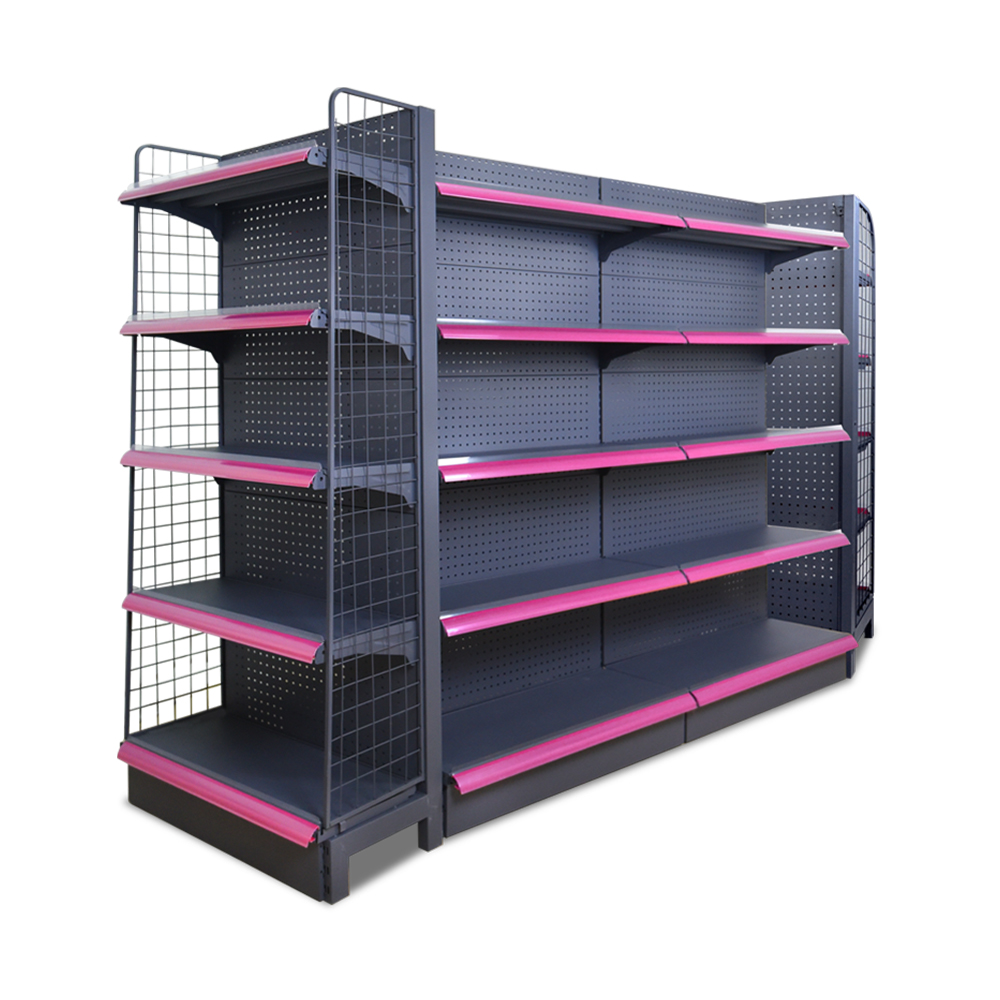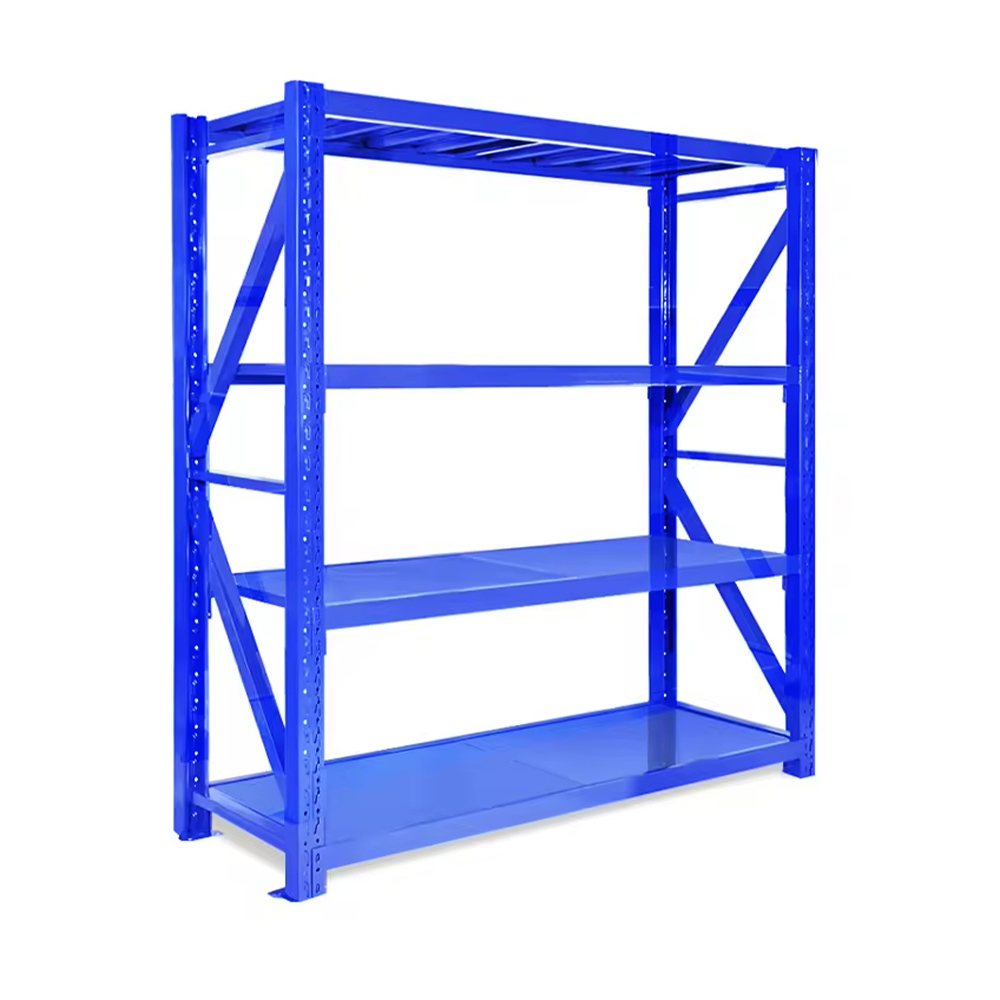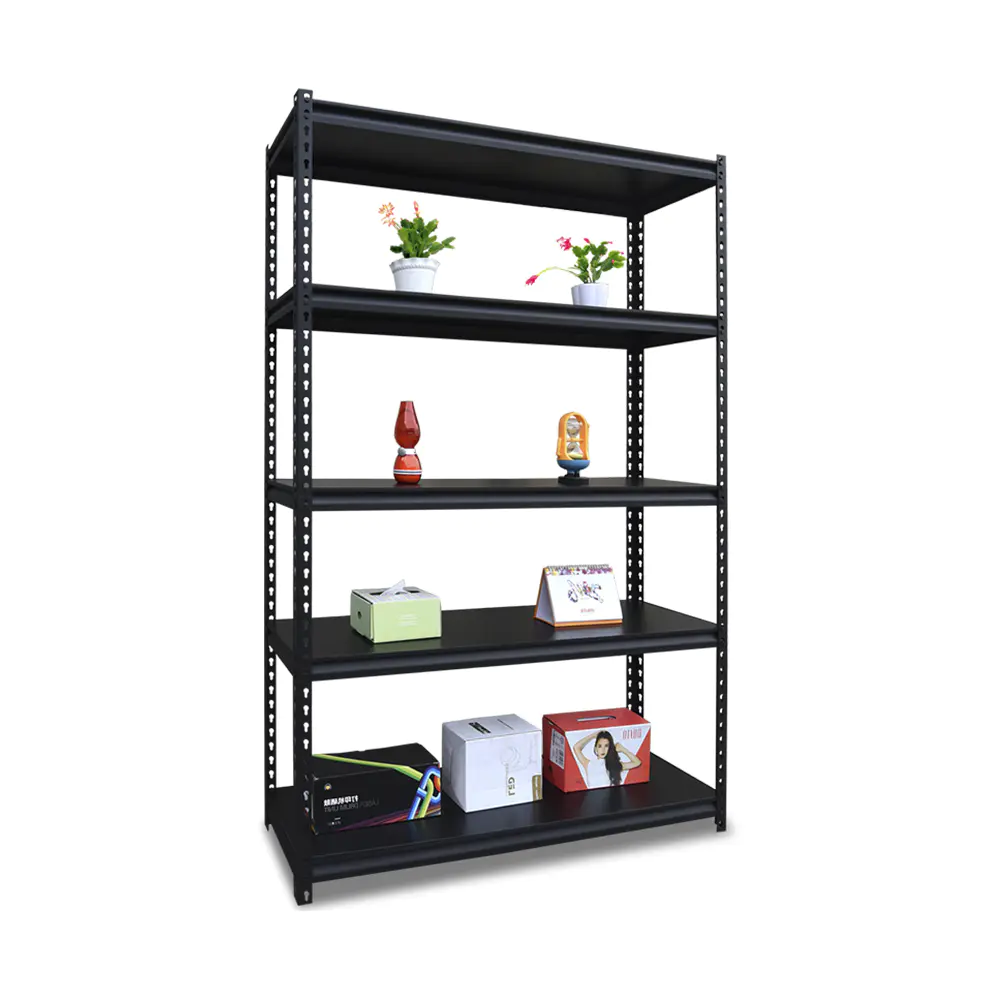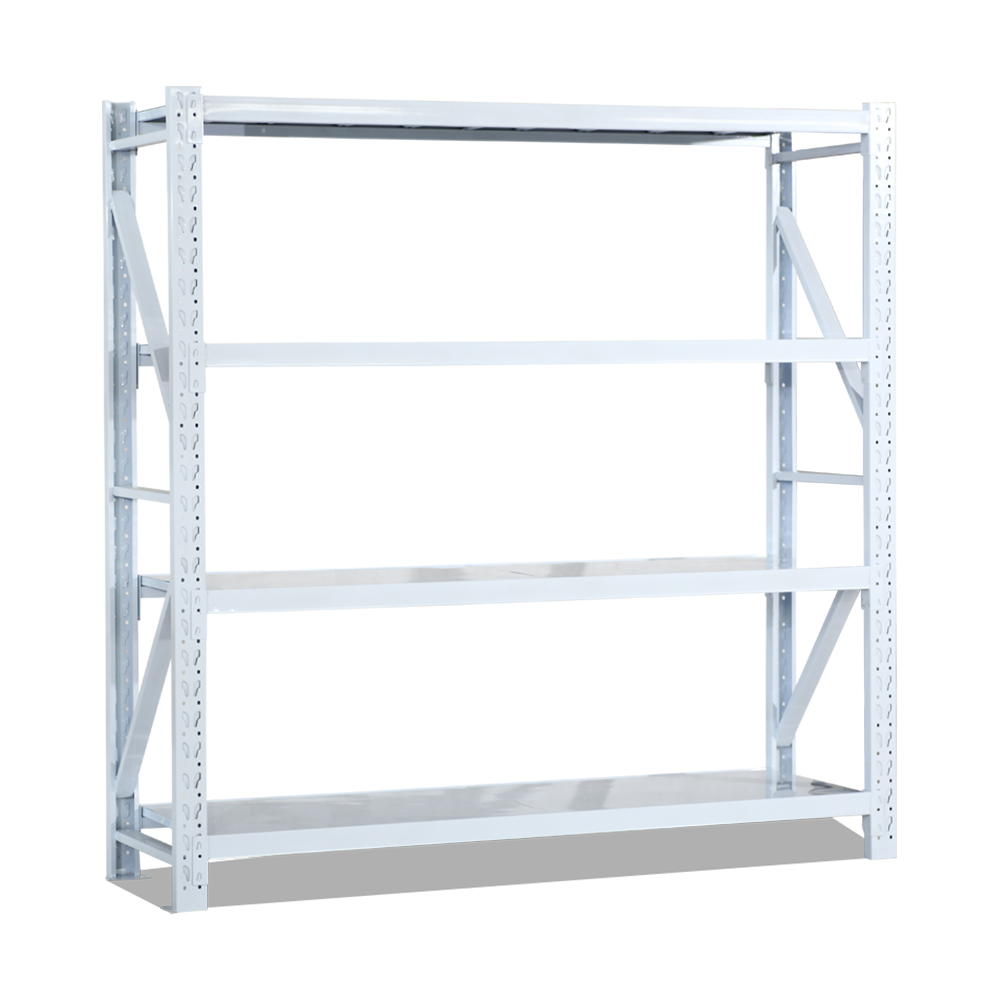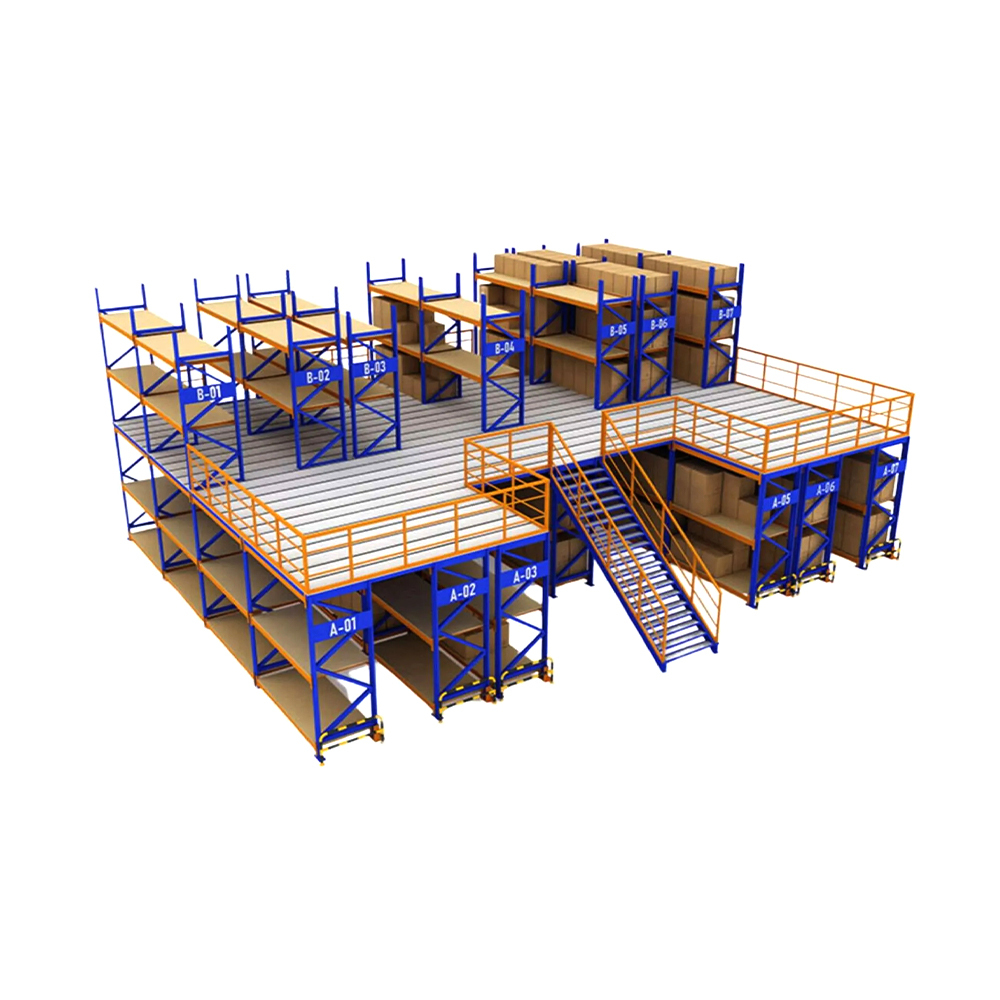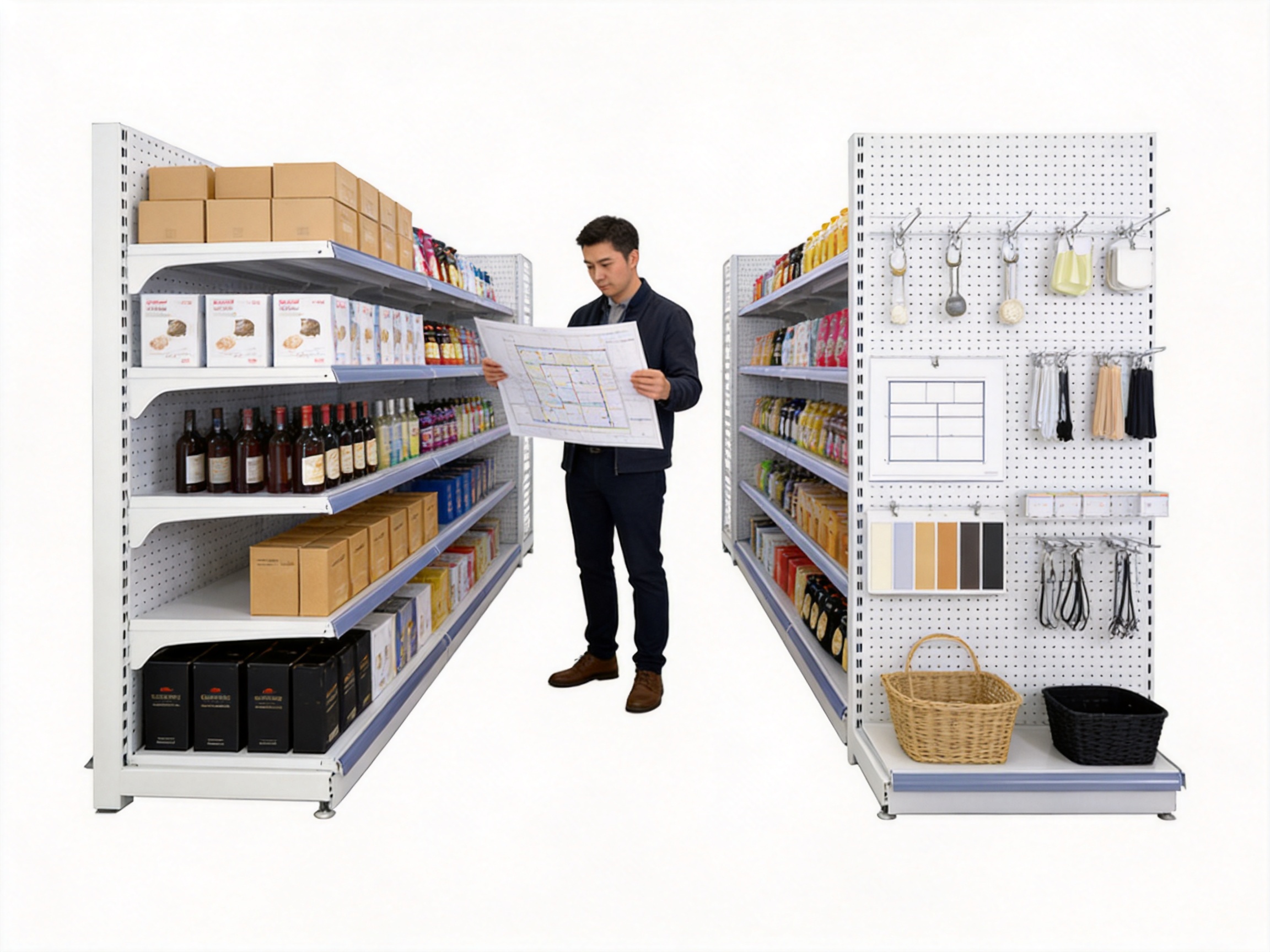
Retail space is one of the most valuable assets in any supermarket, convenience store, specialty shop, or commercial showroom. Every square meter must support product visibility, customer movement, inventory organization, and sales performance. The adjustable double-sided store rack system is designed to help retailers achieve these goals through a practical combination of display capacity, flexible configuration, structural stability, and modern appearance.
Unlike basic single-sided shelving that is usually placed against a wall, this retail rack uses both sides for merchandising. It can be installed in the center of a sales floor, arranged in parallel aisles, or positioned as part of a free-standing product display. Its adjustable shelves make it suitable for merchandise with different dimensions, including packaged food, beverages, household products, personal care items, cosmetics, small appliances, stationery, and general consumer goods.
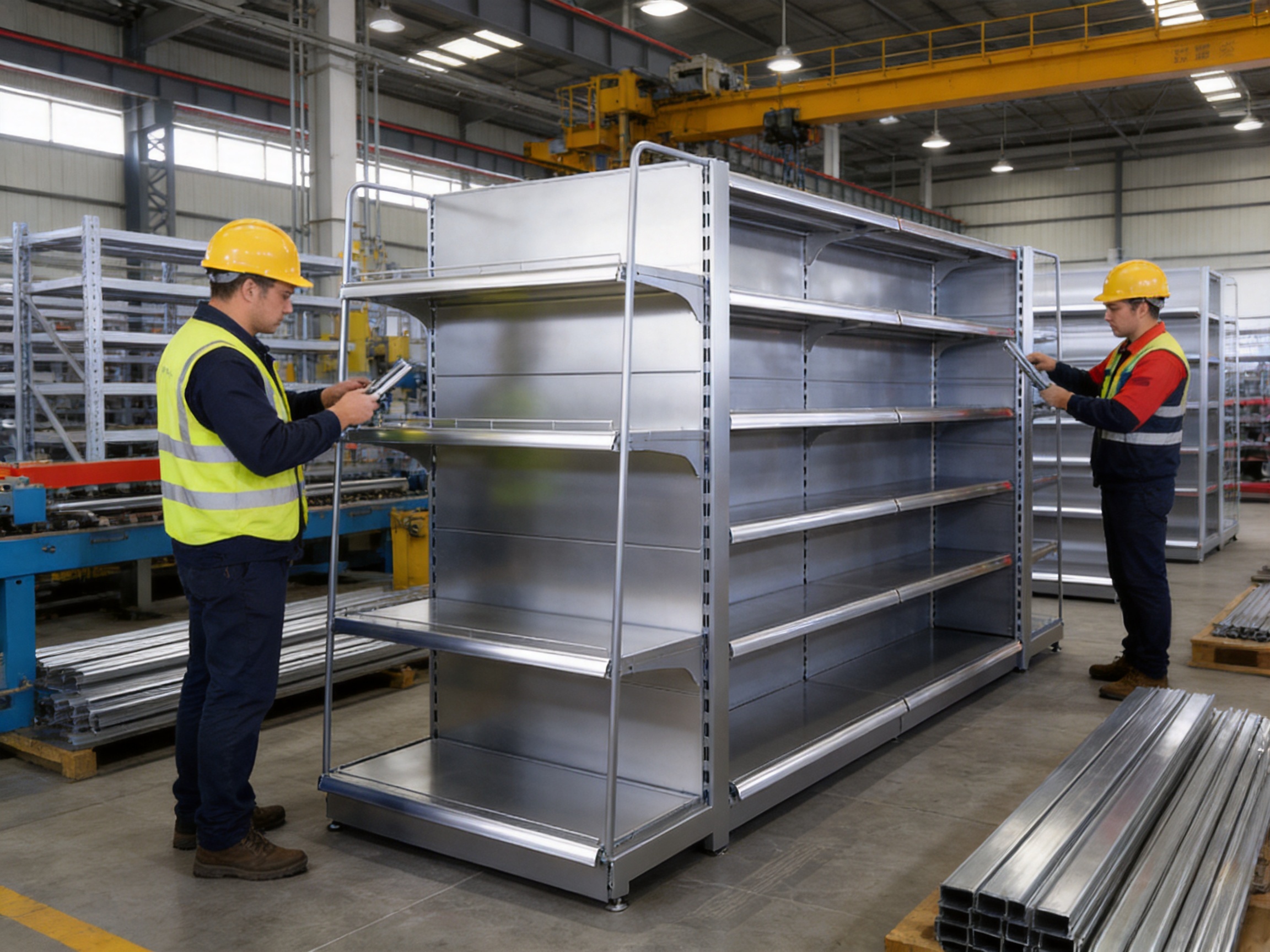
The rack is manufactured from steel and finished with a durable anti-rust powder coating. This construction provides a stable foundation for daily retail operations while helping the product maintain a clean and professional appearance. Grid or pegboard back panels can also be used to support hooks, accessories, promotional materials, and other merchandising components.
Shanghai King Global Shelf Co., Ltd. develops and supplies shelving and storage products for supermarkets, warehouses, offices, homes, and commercial facilities. With an integrated product development, manufacturing, quality control, and service system, the company provides standard shelving products as well as customized OEM and ODM solutions for customers in different markets.
Why Store Layout Efficiency Matters
A well-designed retail shelving system affects much more than storage. It influences how customers enter an aisle, how quickly they locate products, how comfortably they browse, and how likely they are to notice complementary or promotional items. Poorly planned shelving can create unused floor space, obstruct customer movement, make products difficult to see, and increase the time required for replenishment.
The double-sided store rack system addresses these challenges by placing merchandise on both sides of one structural unit. Retailers can display a larger range of products without occupying the floor area required for two separate wall-mounted or single-sided racks. This is especially useful in convenience stores and compact retail locations where every aisle must deliver maximum value.
The open design also creates clear product visibility. Customers can view products from either side while walking through the store, and staff can replenish goods without dealing with enclosed cabinets or complicated access points. When combined with suitable aisle spacing and a logical product arrangement, the rack supports a more efficient and attractive shopping environment.
For larger supermarkets, the rack can be used to create organized product zones. For smaller shops, it can serve as a central island display, promotional fixture, or flexible storage unit. Its adaptable structure makes it suitable for both permanent layouts and seasonal changes.
Core Product Design
Double-Sided Merchandise Display
The defining feature of this system is its double-sided configuration. Products can be placed on shelves facing both directions, which improves the productive use of the floor area. A central rack can separate two product categories, support two complementary merchandising themes, or create a continuous aisle display.
This design offers a major advantage over many conventional single-sided retail shelves. A single-sided unit normally requires a wall or back boundary and uses only one face for product presentation. By contrast, a double-sided rack can stand independently and generate display value from both sides. Retailers can therefore reduce the number of separate fixtures needed for a given product range or use the saved space for customer circulation, promotional stands, checkout displays, or additional merchandise.
The two-sided arrangement is also useful for cross-merchandising. For example, one face can display packaged snacks while the opposite face presents beverages. A household goods section may place cleaning products on one side and storage accessories on the other. In a pharmacy or personal care store, skincare products can face travel-size toiletries or related accessories.
Adjustable Shelf Heights
Retail product dimensions vary considerably. A shelving system designed for only one fixed product size may create wasted vertical space or make larger items impossible to display efficiently. The adjustable shelf structure allows retailers to change shelf positions according to the dimensions of the merchandise.
Shorter shelf spacing can be used for small packaged items, cosmetics, stationery, accessories, and boxed consumer goods. Taller spacing can accommodate bottles, household products, larger food packages, small appliances, and seasonal merchandise. The ability to reposition shelves also allows the same rack to be reused when the store changes its product assortment.
Adjustability improves visual presentation. Products can be positioned at comfortable viewing levels, while the distance between shelves can be reduced to prevent excessive empty space. Retailers can create a denser display for fast-moving small items or a more spacious presentation for premium products that benefit from additional visibility.
Because retail demand changes throughout the year, adjustable shelving is particularly useful for seasonal promotions. A store may require one configuration for holiday gift sets, another for summer beverages, and a third for school supplies. Instead of replacing the entire fixture, staff can reconfigure the shelves to match the new product mix.
Steel Construction
The rack is constructed from steel to provide the rigidity required for commercial use. Steel is widely used in retail and industrial shelving because it offers a practical balance of strength, durability, cleanability, and long service life. A properly engineered steel frame helps the unit remain stable when shelves are loaded and unloaded repeatedly.
The steel construction is also suitable for environments where shelving is exposed to frequent handling. Retail fixtures must tolerate regular contact with shopping baskets, cartons, stocking equipment, cleaning tools, and customer activity. The rack is designed as a durable commercial product rather than a temporary household stand.
Structural performance depends on the complete installation, including the frame, shelves, connectors, back panels, and any required anchoring or leveling components. Customers should select dimensions, shelf quantities, and load requirements according to their intended application. Shanghai King Global Shelf Co., Ltd. can discuss technical specifications and customized configurations for different retail projects.
Anti-Rust Powder Coating
The rack uses a powder-coated finish to provide a protective surface and a clean retail appearance. Powder coating is applied as a dry coating process and then cured to form a durable layer over the prepared steel. The finish helps protect the surface against ordinary wear, humidity, and corrosion-related deterioration during normal indoor use.
In addition to its protective role, the coating supports consistent color and appearance across a store project. A uniform finish helps create a professional brand environment and makes different display zones look coordinated. Multiple color options can be considered to match store branding, interior design, or product category themes.
The coating also makes routine cleaning easier. Smooth, accessible surfaces can generally be wiped with suitable cleaning materials as part of a store’s regular maintenance program. Retailers should follow appropriate cleaning procedures and avoid aggressive chemicals that may damage the finish.
Grid and Pegboard Back Panels
Grid or pegboard back panels expand the merchandising possibilities of the rack. Shelves can support boxed and packaged goods, while hooks and accessories can be used for hanging products. This combination is useful for merchandise that is difficult to present efficiently on a flat shelf.
Hanging displays may be suitable for small tools, household accessories, cables, toys, personal care items, kitchen utensils, packaged accessories, and impulse-purchase products. Pegboard-style surfaces can also support promotional signage or category labels when the appropriate accessories are selected.
The back panels provide a visual boundary between the two sides without completely closing the unit. They can help organize product categories while preserving the open character of the rack. Retailers can select a shelf-and-panel arrangement that reflects the product range, customer traffic, and desired visual density.
Rounded Edges and Customer Safety
Retail fixtures are used in environments with constant customer movement. Smooth, rounded edges help reduce the risk of accidental contact with sharp corners during normal shopping activity. This feature is especially valuable in convenience stores, supermarkets, family-oriented shops, and other busy environments where customers may move quickly through narrow aisles.
Safe design also depends on correct assembly, stable placement, suitable aisle spacing, appropriate loading, and regular inspection. The rack should be installed on a suitable floor and used according to its intended design. Staff should monitor loose components, damaged surfaces, uneven loading, and other conditions that could affect stability.
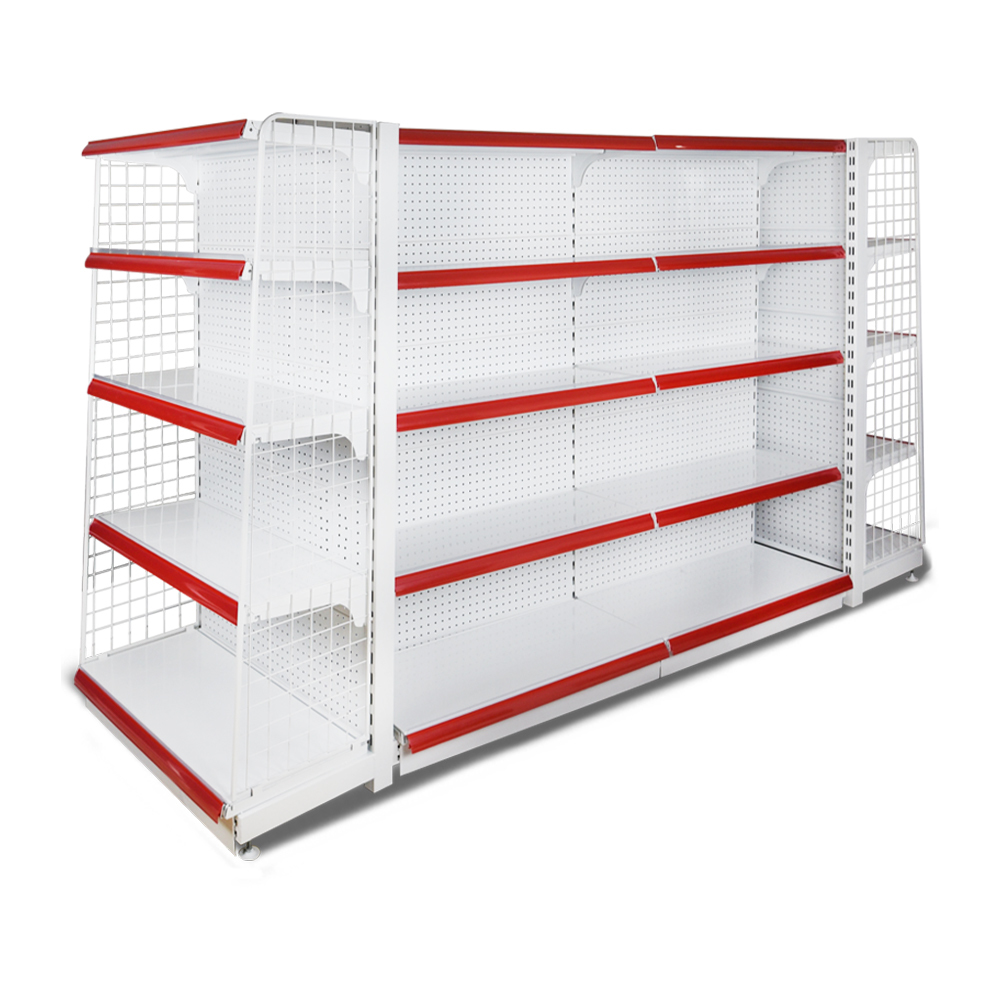
Adjustable Store Rack System for Retail Shop Convenience Store Shelving
Advantages Over Conventional Retail Shelving
More Display Capacity in the Same Floor Area
The most visible advantage over basic wall shelving is the use of both sides. A single-sided unit may provide a straightforward solution for perimeter walls, but it does not make full use of open floor space. The double-sided system transforms central floor areas into productive merchandise zones.
This advantage can reduce the need for additional fixtures when a retailer expands its assortment. It can also help stores maintain a wider range of stock without making the sales floor appear crowded. With careful planning, the retailer can balance display capacity with comfortable customer circulation.
Greater Layout Flexibility
Many fixed retail fixtures are difficult to adapt after installation. Their shelf levels may be permanent, and their placement may be limited to one location. The adjustable store rack system is more flexible because it can be reconfigured as inventory requirements change.
The rack may be used as a central aisle unit, a category divider, a promotional display, or a temporary seasonal fixture. Its ability to be assembled and relocated enables store managers to respond to changes in consumer demand, sales data, and promotional schedules.
This flexibility can reduce the long-term cost of store renovation. Instead of replacing a complete shelving system whenever the merchandise mix changes, the retailer may only need to reposition shelves, add hooks, modify signage, or rearrange the rack layout.
Better Product Visibility
Closed cabinets and heavily enclosed fixtures can hide products from customers. The open design of this rack makes merchandise easier to view and access from both sides. Clear visibility can encourage browsing and help shoppers compare similar products.
Open shelving is also useful for impulse purchasing. Products positioned along high-traffic routes can attract attention without requiring customers to enter a separate department. Retailers can use the rack to present limited-time promotions, new products, seasonal goods, or high-margin accessories.
More Suitable for Mixed Product Ranges
A store often carries products of different sizes, weights, packaging types, and merchandising methods. A fixed shelf designed for one product category may not perform well when used for another. Adjustable shelves and optional grid or pegboard panels make the rack suitable for a broader range of merchandise.
This versatility gives the rack an advantage over narrow-purpose fixtures. It can support flat-packed products, cartons, bottles, hanging packages, display boxes, and accessory items within one coordinated system. Retailers can use different shelf settings on the two sides to create more precise category arrangements.
Professional Appearance
Retail fixtures contribute directly to the impression customers form about a business. A clean, stable, modern rack can make a store appear organized and reliable. The powder-coated finish, symmetrical structure, open product access, and optional color selection support a consistent commercial appearance.
A professional display environment can also simplify staff work. Clearly defined shelves and categories make replenishment more systematic, reduce misplaced products, and help employees identify empty spaces. When each product category has a logical position, customers can navigate the store with less confusion.
Long-Term Reusability
Retail businesses frequently change their product selections, interior layouts, and promotional methods. A reusable rack system can remain valuable through these changes. Adjustable components allow the fixture to serve different purposes over time, which can improve the return on the original investment.
The rack may be moved from one branch to another, transferred from a seasonal display to a permanent aisle, or reconfigured for a new category. This adaptability distinguishes it from disposable promotional furniture or highly specialized fixtures that become unsuitable after a single campaign.
Manufacturing Strengths and Production Capabilities
Integrated Product Development
Shanghai King Global Shelf Co., Ltd. operates as a professional manufacturer specializing in the development, production, and sales of shelving and storage products. An integrated structure allows product design, engineering, production planning, quality control, and customer service to work together.
For a retail rack system, integrated development is important because performance depends on many connected details. Shelf adjustment, frame stability, panel compatibility, surface treatment, assembly method, packaging, and shipping protection must be considered as one product system. Engineering coordination helps ensure that the final rack is practical for real retail conditions.
The company provides standard products for common applications while also supporting OEM and ODM projects. Customers may require different dimensions, colors, shelf quantities, panel styles, accessories, packaging methods, or branding arrangements. A professional manufacturer can review these requirements and develop a suitable production plan.
Modern Production Base
The company operates a 60,000-square-meter production base and employs more than 300 people. This scale supports organized manufacturing, project coordination, quality management, and production scheduling for both standard and customized products.
A substantial production base can also help manage larger orders and repeat programs. Retail chains, distributors, wholesalers, and project contractors may require consistent products across multiple locations. Controlled manufacturing processes help support repeatability in dimensions, appearance, component matching, and packaging.
Production scale should not be viewed only as a measure of output. It also provides the resources needed for engineering support, material management, process supervision, equipment maintenance, and shipment coordination. These functions are important when customers require reliable delivery of complete store fixtures.
Material Preparation and Component Control
Reliable shelving begins with suitable raw materials and controlled component dimensions. Steel sections, panels, shelves, brackets, connectors, and accessories must be selected according to the intended product design. Consistent material preparation helps reduce variation during forming, welding, assembly, and finishing.
Component control is particularly important for adjustable systems. Shelf supports must align correctly with the frame, and connection points must remain compatible when shelves are moved to different levels. Consistent hole spacing, connector positioning, and component tolerances support easier installation and reconfiguration.
Manufacturing teams can also organize components according to product models and customer orders. This helps prevent mixing parts between configurations and makes final packing more systematic. Clear production identification is valuable for large projects containing several rack sizes or accessory combinations.
Metal Forming and Fabrication
Steel shelving components require accurate forming to achieve a consistent appearance and reliable fit. Frames, shelf panels, support members, and back panels can be processed through controlled fabrication procedures appropriate to their design.
Accurate forming contributes to several product benefits. Shelves are easier to install when their dimensions are consistent. Frames look more uniform when components are properly aligned. A well-formed shelf also helps distribute merchandise across its supporting structure. Fabrication quality therefore affects both visual presentation and practical usability.
For customized orders, the manufacturing team can adapt fabrication arrangements to the required size, configuration, and accessory package. The specific process depends on the product design, material thickness, dimensions, and production quantity. Technical review before mass production helps ensure that the proposed design can be manufactured efficiently.
Welding and Structural Assembly
Where welded construction is used, controlled welding helps join steel components into stable structural sections. Welding quality influences the alignment, strength, and appearance of the finished frame. Production personnel must manage joint preparation, welding parameters, component positioning, and post-process inspection.
Some shelving structures may also use bolted or interlocking connections to support assembly and reconfiguration. The choice of connection method depends on the product model and customer requirements. A well-designed system balances structural stability with practical installation and transportation considerations.
Before finishing, fabricated components can be checked for alignment, surface defects, dimensional consistency, and connection quality. Identifying issues before coating is beneficial because corrections are generally easier during the fabrication stage than after final assembly.
Surface Preparation and Powder Coating
Surface preparation is an important stage in the appearance and durability of a powder-coated steel rack. The steel surface must be appropriately prepared so that the coating can adhere evenly. Production control may include cleaning, treatment, drying, coating application, and curing according to the selected finish.
Powder coating supports a consistent surface appearance across frames, shelves, and panels. The finish can be selected in different colors for project coordination. A controlled coating process helps produce a smooth commercial appearance suitable for supermarkets, convenience stores, showrooms, offices, and other customer-facing spaces.
Coating inspection may consider color consistency, coverage, adhesion, surface smoothness, and visible defects. Packaging must also protect the coated parts from scratching during storage and transportation. These details are important because retail customers see the finished surface every day.
Quality Control Through Multiple Stages
Quality should not be treated as a single inspection performed at the end of production. Effective quality control begins with product design and continues through material preparation, fabrication, coating, assembly, packing, and shipment.
For this type of rack, quality checks may review key dimensions, shelf fit, frame alignment, surface condition, accessory compatibility, component quantity, and package identification. Where a customized project includes different rack sizes or colors, production records can help ensure that each order is assembled according to the approved specifications.
Final inspection is also important for confirming that the shipment contains the necessary components and installation materials. A complete package reduces delays at the customer’s site and supports a smoother installation process.
Packaging and Export Experience
Retail shelving is commonly shipped in multiple components to improve transportation efficiency. Proper packaging must protect coated steel parts, corners, panels, shelves, connectors, and small hardware during handling and transit.
Shanghai King Global Shelf Co., Ltd. exports products to North America, Southeast Asia, Japan, South Korea, the Middle East, Europe, and other regions. International shipping experience helps the company understand the importance of labeling, package organization, documentation, loading efficiency, and communication with overseas customers.
Export-oriented production also requires attention to different market preferences. Retailers in different regions may request different dimensions, colors, merchandising accessories, packaging styles, or installation instructions. Experience with international customers supports more effective project coordination.
Product Specification Planning
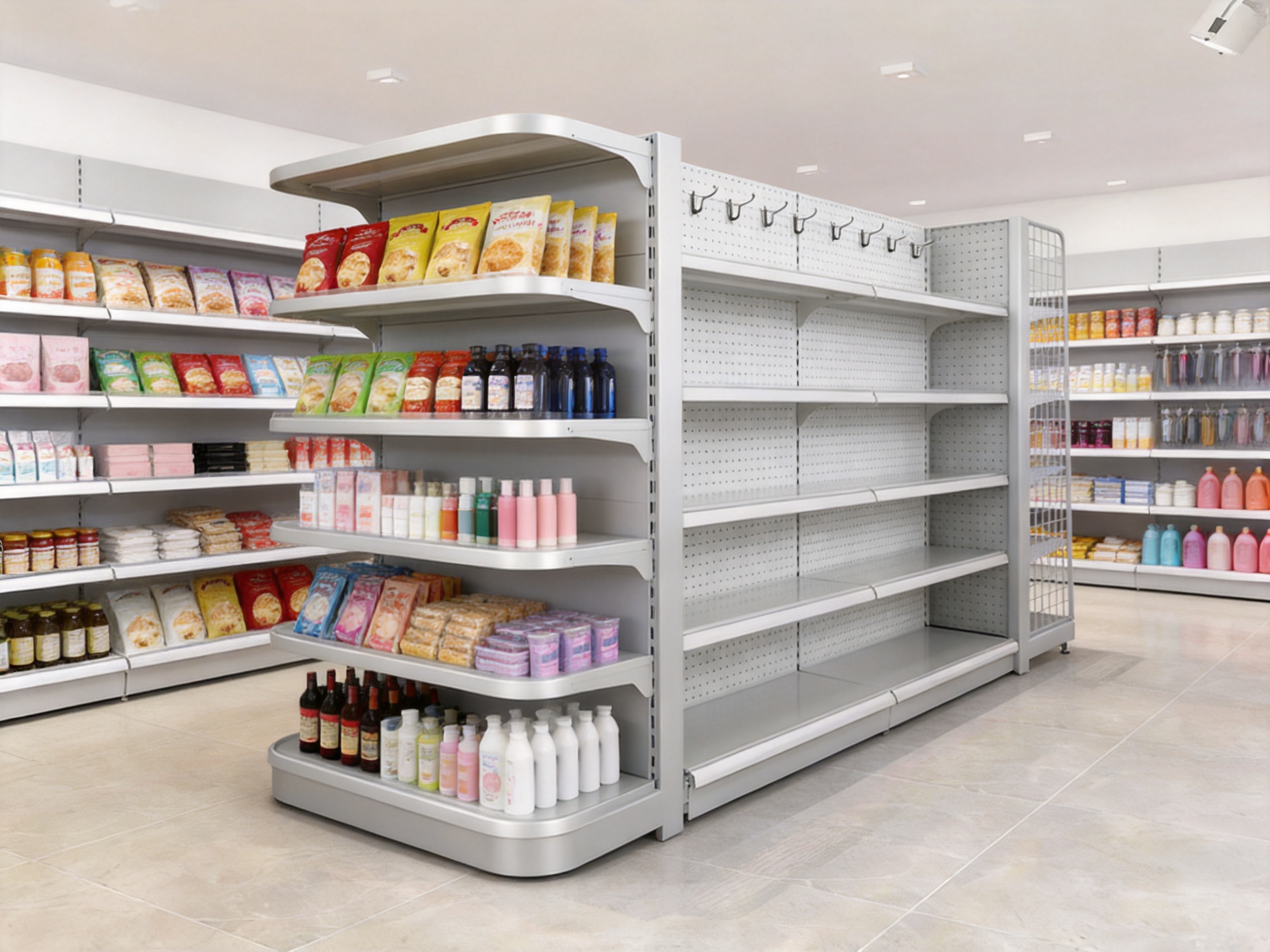
The most suitable rack configuration depends on the store’s merchandise, available floor area, customer traffic, and display objectives. Before placing an order, customers should define the basic application and identify the products to be displayed.
| Planning Item | Key Consideration | Benefit |
|---|
| Rack orientation | Central aisle, wall-adjacent, category divider, or promotional zone | Supports efficient store layout planning |
| Number of sides | Double-sided display for independent floor placement | Improves use of available floor space |
| Shelf configuration | Quantity, spacing, depth, and adjustment positions | Accommodates different product dimensions |
| Back panel type | Grid, pegboard, open, or selected panel arrangement | Supports shelves, hooks, signage, and accessories |
| Finish | Color and surface treatment | Matches store branding and interior design |
| Accessories | Hooks, brackets, labels, dividers, and promotional holders | Improves product organization and visual communication |
| Loading requirements | Product weight and distribution across each shelf | Helps select an appropriate commercial configuration |
| Installation method | Assembly location, floor condition, and layout sequence | Reduces installation time and adjustment difficulties |
Dimensions and Floor Planning
Rack dimensions should be selected according to the store’s clear height, aisle width, entrance access, emergency routes, columns, doors, checkout area, and customer circulation patterns. A taller fixture may increase vertical display capacity, but it must remain appropriate for the store environment and customer reach requirements.
Rack depth should also be considered. Deeper shelves can hold larger products but may reduce aisle space. Shallower shelves may be preferable for small packaged goods, cosmetics, accessories, and high-visibility displays. The best configuration balances storage density with product accessibility and comfortable browsing.
Retailers should prepare a layout plan before delivery when multiple racks are being installed. A plan can identify the location of each category, the direction of customer flow, the position of promotional areas, and the clearance required for replenishment. This preparation helps the installation team place the fixtures efficiently.
Load Distribution
Products should be distributed evenly across the shelf surface whenever possible. Heavy products are generally better placed on lower levels, while lighter or smaller items can be displayed higher. Even distribution helps maintain stability and makes the display easier for customers to use.
Retailers should not exceed the load limits specified for the selected configuration. Actual capacity can depend on shelf dimensions, material design, support spacing, installation quality, and the way products are arranged. Customers should request technical load information for their intended application rather than relying on general assumptions.
Color and Brand Coordination
Color selection can support wayfinding and brand recognition. A neutral finish may suit a broad range of merchandise, while a branded color may help distinguish a store’s identity. Different colors can also be used to separate departments or create promotional zones.
For chains and franchise groups, consistent color and component selection can help create a unified appearance across branches. For independent stores, customized color choices can complement the existing interior, signage, flooring, and lighting.
Applications in Different Retail Environments
Convenience Stores
Convenience stores need high product turnover, clear visibility, rapid replenishment, and efficient use of compact spaces. The double-sided rack can display snacks, beverages, personal care products, household basics, travel items, and impulse-purchase goods.
Its adjustable shelves allow the store to respond to different package sizes, while the open access supports quick customer selection. A central rack can create a short aisle without making the store feel closed or difficult to navigate.
Supermarkets
Supermarkets can use the rack for packaged goods, household merchandise, seasonal promotions, accessories, and special display areas. Because the rack can be configured on both sides, it is suitable for creating organized departments and cross-merchandising zones.
For example, one side can support everyday grocery items while the other side presents household or personal care products. The rack can also be positioned near endcap areas to reinforce promotional themes or introduce new product lines.
Specialty Shops
Specialty retailers often need flexible display methods because their merchandise may include products with unusual shapes, different packaging styles, or changing collections. Grid and pegboard back panels offer additional options for hanging goods and arranging small accessories.
In electronics and accessory shops, hooks and shelves can be combined to display cables, cases, chargers, small devices, and boxed items. In beauty stores, adjustable shelves can support bottles, gift sets, and promotional displays. In household shops, the rack can combine hanging tools with boxed and packaged products.
Showrooms and Commercial Displays
The modern appearance of the rack makes it suitable for showrooms and commercial display environments. It can present products while preserving a clean, organized visual structure. Retailers may use different shelf heights to create a stepped presentation or separate premium merchandise from standard products.
Because the system can be relocated, it may also be useful for exhibitions, temporary sales areas, pop-up stores, and promotional campaigns. The exact suitability depends on the required transport frequency and installation method.
Office and Home Retail Sections
Stores selling office supplies, home organization products, and small furnishings can use the rack to display products of different sizes. Adjustable shelving is useful for file products, storage boxes, stationery, kitchen accessories, cleaning supplies, and household organizers.
The rack’s neutral steel construction can complement practical retail environments where durability and easy maintenance are important. Its open structure allows shoppers to compare products without opening cabinets or moving through enclosed displays.
Assembly, Relocation, and Maintenance
Efficient Assembly
The rack is supplied with necessary hardware and installation guidance for assembly. A clear assembly process helps retailers reduce setup time, especially when multiple units are required. Before installation, staff should check the package contents, identify the components, and prepare a clean, level work area.
Assembly should follow the provided instructions and should not be improvised by replacing structural components with unsuitable hardware. Frames, shelves, panels, connectors, and accessories must be installed in the intended sequence. After assembly, the rack should be checked for level, stability, alignment, and secure connections.
Reconfiguration
One of the system’s practical advantages is the ability to change shelf positions and merchandising arrangements. Reconfiguration should be carried out by trained store personnel using appropriate tools and safe handling procedures. Products should be removed from the rack before shelves are repositioned.
When changing the layout, staff should confirm that the new shelf positions are properly supported and that the product load remains appropriate. The two sides can be configured differently when this supports better category presentation, but heavy or unbalanced loading should be avoided.
Relocation
The rack’s modular structure allows it to be relocated when a store changes its layout or transfers the fixture to another site. Before moving the unit, merchandise must be removed and loose accessories should be packed separately. Larger units may require more than one person or suitable handling equipment.
After relocation, the rack should be inspected for damage, leveled on the new floor, and checked again for stability. Relocation is an advantage, but repeated movement should still be performed carefully to protect the coating, frame, floor, and connecting components.
Routine Maintenance
Regular maintenance helps preserve both appearance and performance. Staff can inspect shelves, brackets, connectors, panels, and frame sections during routine store cleaning. Dust and ordinary surface dirt can generally be removed with suitable cleaning materials and a soft cloth.
Any signs of loose hardware, bent components, damaged coating, corrosion, or unusual movement should be addressed promptly. Damaged structural components should not continue to carry merchandise until they have been evaluated and repaired or replaced.
Keeping product loads within the approved limits is also part of maintenance. Overstocking may place unnecessary stress on shelves and can make products difficult for customers to remove safely.
OEM and ODM Customization
Different retailers have different requirements for dimensions, color, shelf depth, panel style, accessories, packaging, and branding. A standard rack is suitable for many applications, but customized production can provide a closer match to a specific store concept or distribution program.
Custom Dimensions
Custom height, width, and depth can help the rack fit a particular room, aisle, wall, or product range. Customers may request a configuration for compact convenience stores, large supermarket aisles, specialized display areas, or warehouse-style retail environments.
Dimension changes should be reviewed from both design and manufacturing perspectives. The selected dimensions must support appropriate structural performance, shelf adjustment, packaging, shipping, and installation. Early technical communication helps avoid changes after production has started.
Custom Colors and Finishes
OEM and ODM projects may include custom colors that reflect a retailer’s brand identity. Consistent color can be especially important for chain stores, franchised locations, and distributors selling under a private label.
The finish selection should consider the store environment, expected handling, cleaning requirements, and overall visual design. The manufacturer can discuss available powder-coating options and coordinate color confirmation before mass production.
Custom Accessories
Retailers may require different hooks, label holders, dividers, brackets, baskets, signage supports, or promotional components. Accessories can improve the usefulness of the rack and help tailor each side to a particular product category.
For example, one side may use flat shelves for cartons while the other side uses hooks for hanging merchandise. A mixed arrangement can increase product variety without requiring multiple unrelated fixture types.
Private-Label Packaging
Distributors and retail equipment suppliers may require packaging that reflects their own brand or sales channel. Packaging can include product identification, assembly information, barcode systems, carton markings, and project references as agreed during order planning.
Clear packaging organization is especially valuable for large projects in which many components must be distributed to different stores. Proper identification can simplify receiving, inventory control, and installation scheduling.
Why Choose an Experienced Manufacturer
The quality of a retail rack depends on more than its appearance in a product photograph. Material selection, fabrication accuracy, coating quality, component compatibility, packaging, and after-sales communication all influence the customer’s experience.
An experienced manufacturer can help customers choose a suitable configuration instead of simply supplying isolated components. The manufacturer can review the store application, product dimensions, estimated order quantity, preferred appearance, shipping destination, and installation conditions.
Shanghai King Global Shelf Co., Ltd. has been engaged in shelving and storage product development, manufacturing, and sales since 2010. Its product range serves supermarkets, warehouses, offices, homes, and commercial facilities. This broad application experience helps the company understand the different priorities of retail and storage projects.
The company’s more than 300 employees and 60,000-square-meter production base support coordinated manufacturing and project management. Its export experience across North America, Southeast Asia, Japan, South Korea, the Middle East, Europe, and other regions demonstrates familiarity with international customer requirements and cross-border supply processes.
Its OEM and ODM capability is also important for customers seeking more than an off-the-shelf fixture. Retail chains, importers, distributors, contractors, and store designers can work with the manufacturer to develop products that match their commercial requirements.
Recommended Purchasing Process
Step One: Define the Retail Application
Identify the store type, product categories, expected traffic, available floor area, and display objectives. A convenience store may prioritize compactness and rapid replenishment, while a supermarket may require larger quantities and category-based layouts.
Step Two: Prepare Product Information
Provide the approximate dimensions and weights of the products to be displayed. Include photographs or packaging details when possible. This information helps determine shelf spacing, depth, accessory requirements, and the most practical configuration.
Step Three: Confirm Layout Requirements
Share the proposed rack position, aisle arrangement, store height, access route, and quantity required. A basic floor plan can help the manufacturer understand how the racks will be used and whether a standard or customized solution is more suitable.
Step Four: Review Samples or Technical Drawings
Before mass production, customers should review the proposed dimensions, colors, shelf arrangement, panel type, accessories, and packaging. Technical drawings or samples can help identify adjustments at an early stage.
Step Five: Confirm Quality and Delivery Details
Order specifications should clearly define materials, surface treatment, inspection arrangements, packaging, delivery schedule, and documentation. Clear communication reduces the possibility of misunderstanding between the buyer, manufacturer, logistics provider, and installation team.
Frequently Asked Questions
What makes this rack different from a standard retail shelf?
The rack is designed for double-sided product display, allowing it to stand independently in the sales area and present merchandise from both faces. It also includes adjustable shelving, steel construction, anti-rust powder coating, and optional grid or pegboard back panels.
Can the shelf levels be changed after installation?
Yes. The shelves are designed to be adjustable so retailers can accommodate different product heights and modify the layout for seasonal or promotional merchandise. Products should be removed before adjustment, and the shelves must be reinstalled securely.
What kinds of products can be displayed?
The rack is suitable for many retail products, including snacks, packaged food, beverages, cosmetics, personal care products, household goods, stationery, small appliances, accessories, and other consumer merchandise. The most suitable configuration depends on product dimensions and weight.
Can one side use shelves while the other side uses hooks?
Depending on the selected design, grid or pegboard panels can support merchandising accessories such as hooks, while the other side can use flat shelves. Customers should confirm the desired combination with the manufacturer before ordering.
Is the rack suitable for a small convenience store?
Yes. Its double-sided design can help small stores use central floor space efficiently. Adjustable shelf levels allow the retailer to display a varied product range without needing a separate fixture for every product size.
Can the rack be used in a supermarket?
Yes. Supermarkets can use it for general merchandise, packaged goods, promotional zones, seasonal displays, accessories, and cross-merchandising areas. Multiple units can be arranged in aisles or product departments.
Is the powder coating resistant to rust?
The anti-rust powder-coated finish is designed to improve surface protection and corrosion resistance during normal indoor use. Long-term performance also depends on the environment, cleaning practices, handling, and whether the surface is damaged.
Are different colors available?
Multiple colors can be considered to match store branding and interior design. The available color range, minimum order requirements, and production conditions should be confirmed for each project.
Can the dimensions be customized?
OEM and ODM services allow customers to discuss custom dimensions, shelf arrangements, panel styles, finishes, accessories, packaging, and other requirements. Technical feasibility and production conditions should be reviewed before approval.
How should the rack be maintained?
Retail staff should clean the surfaces using suitable materials, check connectors and supports, avoid overloading shelves, and inspect the unit for damage or instability. Any structural issue should be corrected before the rack is returned to service.
Does the rack require professional installation?
The rack is supplied with installation hardware and instructions, allowing suitable store personnel to assemble it. For large projects, multi-unit installations, or customized systems, professional installation may help ensure efficient and consistent results.
How can buyers select the correct configuration?
Buyers should consider the store layout, product dimensions, product weight, desired display capacity, shelf depth, rack height, color, accessories, and shipping requirements. Providing this information to the manufacturer allows the proposed configuration to be reviewed more accurately.
Conclusion
The adjustable double-sided store rack system is a practical solution for retailers seeking higher display capacity, flexible merchandising, and dependable commercial construction. Its two-sided design makes better use of open floor space, while adjustable shelves allow the same fixture to accommodate a wide range of products and changing seasonal requirements.
Steel construction provides a stable foundation for daily retail use, and the anti-rust powder-coated finish supports a professional appearance and long-term surface protection. Grid or pegboard back panels expand the merchandising options by allowing hooks, accessories, signage, and hanging products to be integrated with conventional shelves.
Compared with fixed single-sided shelving, the system offers greater layout flexibility, improved product visibility, broader product compatibility, and stronger reusability. It can serve convenience stores, supermarkets, specialty shops, showrooms, office supply retailers, home goods stores, and other commercial environments.
Shanghai King Global Shelf Co., Ltd. strengthens this product offering through integrated development, organized manufacturing, quality control, international supply experience, and OEM and ODM support. Its 60,000-square-meter production base, professional technical team, more than 300 employees, and experience serving customers in multiple global regions provide a solid foundation for both standard products and customized retail projects.
For customers planning a new store, renovating an existing sales floor, expanding a retail chain, or developing a private-label shelving program, the system offers a balance of flexibility, appearance, durability, and manufacturing support. With the correct dimensions, shelf arrangement, accessories, and installation plan, it can help transform available floor space into an organized and productive retail display environment.
References
1. Shanghai King Global Shelf Co., Ltd. Product information for adjustable retail store rack systems and supermarket shelving.
2. Shanghai King Global Shelf Co., Ltd. Corporate information concerning shelving manufacturing, OEM and ODM services, production capacity, and international markets.
3. General principles of retail space planning, merchandise presentation, customer circulation, and store fixture selection.
4. General steel shelving design and maintenance practices for commercial storage and display environments.
5. General powder-coating principles for steel products, including surface preparation, protective finishing, appearance control, and maintenance considerations.


 English
 Español
 русский
 Français
 한국어
 عربى
 ไทย
 Deutsch
 Bahasa Melayu
 Português
 Polskie