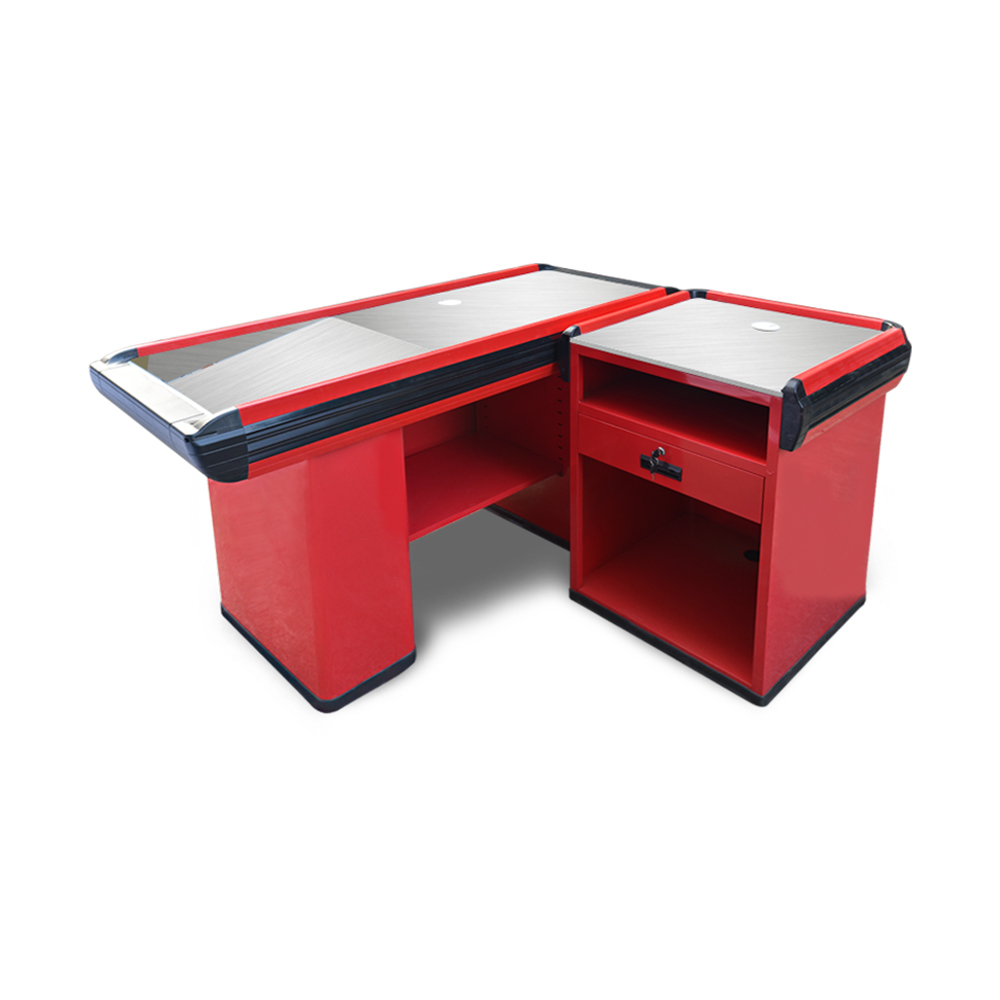
In modern retail, the checkout area is much more than a place where customers pay for their purchases. It is the final operational stage of the shopping journey, the last opportunity to create a positive impression, and one of the most important workstations for store employees. A well-designed checkout counter can help reduce transaction time, organize equipment, improve staff comfort, protect cash, and make better use of limited retail floor space.
The Retail Supermarket Cashier Checkout Counter Desk is designed to combine these functions in one practical retail workstation. It integrates a durable countertop, built-in cash drawer space, scanner placement, organized equipment areas, and a compact structure suitable for supermarkets, convenience stores, boutiques, pharmacies, gift shops, trade shows, and other commercial environments.
Manufactured by Shanghai King Global Shelf Co., Ltd., the counter is part of a broader range of shelving, storage, display, and customized retail solutions. The company has developed experience in product development, manufacturing, quality control, and international market service. Its production capabilities support both standard products and OEM/ODM projects for customers with specific dimensions, layouts, branding requirements, and operational needs.
This article examines the product’s design, practical advantages, manufacturing strengths, installation considerations, maintenance requirements, and suitability for different retail applications. It also explains why an integrated checkout counter can provide greater value than a collection of separate desks, tables, and equipment stands.
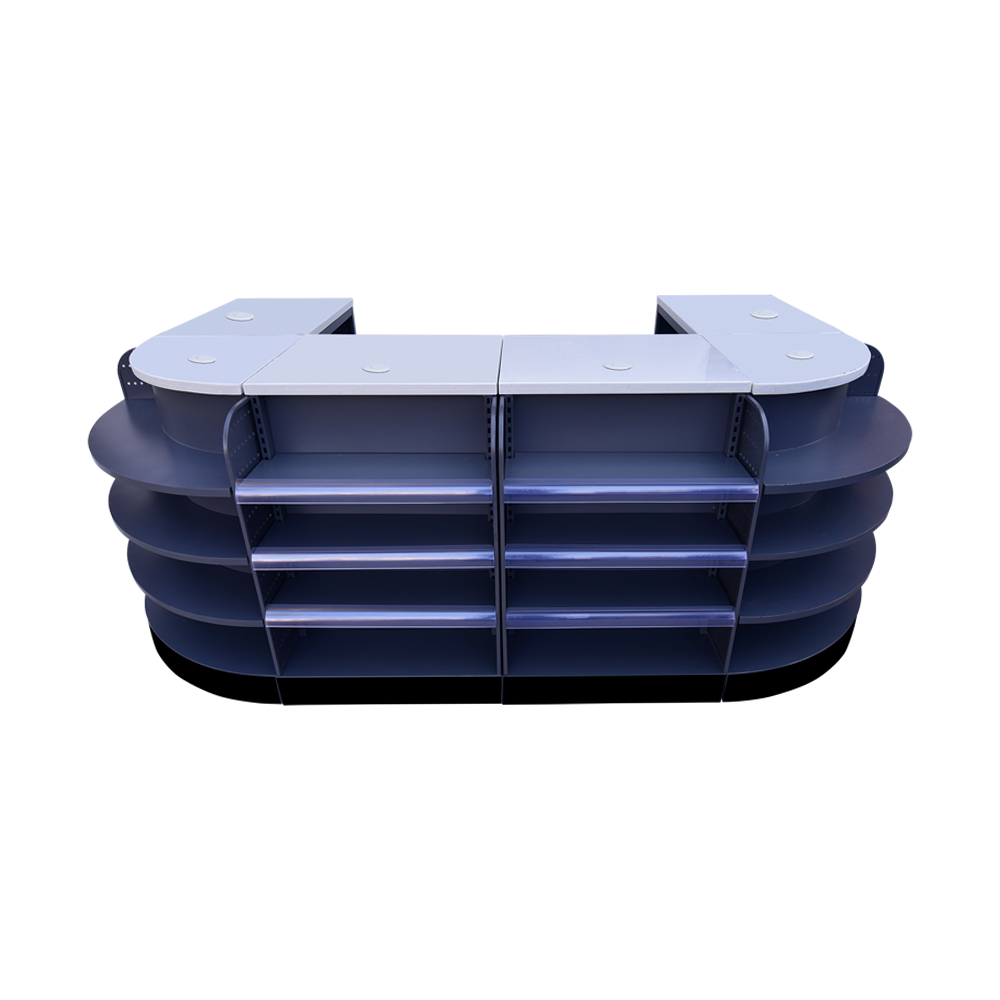
Retail Supermarket Cashier Checkout Counter Desk
1. The Role of the Checkout Counter in Modern Retail
The checkout counter is one of the most frequently used fixtures in a retail store. Unlike many display shelves that may be touched occasionally, the checkout station is involved in nearly every completed transaction. It must support repeated scanning, bagging, payment processing, cash handling, customer communication, and merchandise placement throughout the business day.
A poorly planned checkout area can create several operational problems. Employees may need to reach across wide surfaces to access equipment, customers may not know where to place their goods, and scanners or payment devices may occupy valuable countertop space. Loose cables, insufficient storage, unstable furniture, and exposed cash drawers can further reduce efficiency and create safety concerns.
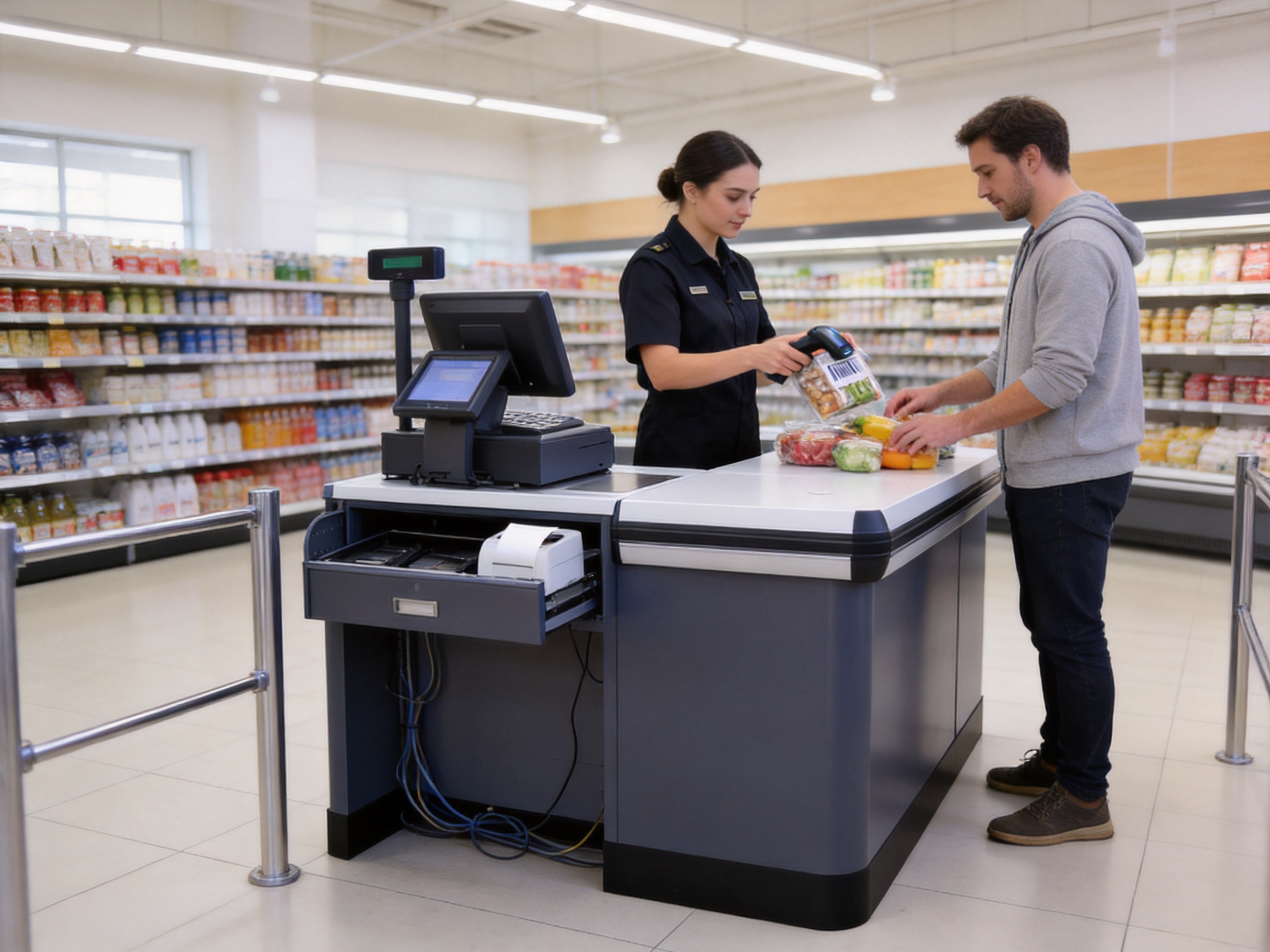
A purpose-built checkout counter addresses these challenges through an organized workstation layout. The cashier has a defined area for operating the point-of-sale system, the scanner has a suitable position, the cash drawer is integrated into the counter structure, and customers have a clear place to present and collect their goods. These details may appear simple, but they can have a significant effect on transaction speed and the overall shopping experience.
For small and medium-sized retailers, space efficiency is particularly important. A store cannot always dedicate a large area to checkout operations. The counter therefore needs to deliver essential functions without occupying unnecessary floor space. A compact design allows the retailer to preserve more room for product displays, promotional areas, customer circulation, and additional revenue-generating merchandise.
1.1 The Checkout Area as a Customer Touchpoint
Customers often judge a store by the ease and professionalism of the checkout process. Long queues, crowded counters, unclear payment areas, and disorganized equipment can make a store feel inefficient even when its product selection is strong. In contrast, a clean and organized checkout station can create a sense of reliability and convenience.
The anti-slip countertop supports orderly product handling. Goods can be placed on a stable surface while the cashier scans them, and the design helps reduce unnecessary movement during payment. An organized layout also gives customers a clear visual indication of where to place products, where to pay, and where to collect their purchases.
For retailers seeking repeat business, checkout quality is especially important. A smooth final interaction can influence whether customers return, recommend the store, or choose the same retailer for future shopping. The checkout counter is therefore both an operational tool and part of the store’s customer-service strategy.
2. Product Overview and Integrated Design
The Retail Supermarket Cashier Checkout Counter Desk is an all-in-one workstation developed for practical daily retail use. Instead of requiring several separate furniture pieces, the counter brings the main checkout functions together within one coordinated structure.
Its principal design features include a sturdy frame, an anti-slip countertop, a built-in cash drawer area, dedicated space for a scanner, a compact footprint, and a surface that is easy to clean. These features are intended to support fast transactions while maintaining a neat and professional retail environment.
The counter can be adapted for different store layouts through customizable sizing. This is valuable for retailers working with narrow aisles, irregular floor plans, multiple checkout lanes, or brand-specific interior designs. A customized counter can be planned around the position of electrical outlets, customer entry and exit paths, point-of-sale equipment, product bagging requirements, and available wall or floor space.
2.1 Main Product Features
| Feature |
Operational Benefit |
Suitable Retail Requirement |
| Sturdy structure |
Provides stable support during repeated daily use |
Busy checkout environments and commercial stores |
| Built-in cash drawer space |
Helps organize and secure cash-handling equipment |
Supermarkets, convenience stores, boutiques, and pharmacies |
| Scanner space |
Creates a defined position for barcode-scanning equipment |
Stores using barcode-based checkout procedures |
| Anti-slip countertop |
Supports safer and more stable product placement |
Retail transactions involving packaged goods and merchandise |
| Compact design |
Preserves valuable sales-floor and customer circulation space |
Small and medium-sized stores with limited floor area |
| Customizable dimensions |
Allows the counter to fit different layouts and workflows |
OEM, ODM, renovation, and new-store projects |
| Easy-clean surfaces |
Helps maintain hygiene and a professional appearance |
High-contact retail environments and daily operations |
2.2 A Single Coordinated Workstation
One of the primary advantages of the product is its integrated structure. When a retailer assembles a checkout area from unrelated tables, cabinets, and stands, the result may include uneven heights, wasted gaps, exposed cables, and difficult-to-clean spaces. Separate furniture can also shift during use or create obstacles for employees and customers.
An integrated checkout counter reduces these issues by coordinating the main working surfaces and storage areas. The cashier can operate within a defined workstation, while the store maintains a cleaner visual appearance. This also simplifies planning because the retailer does not need to source every component independently.
The integrated design can help reduce the time required for store setup. Rather than arranging multiple units and attempting to align them, the retailer can install a purpose-designed counter and position the necessary payment and scanning equipment. This is especially useful for new stores, shop renovations, temporary retail environments, and rapidly expanding store networks.
3. Advantages Compared with Conventional Checkout Furniture
Retailers often compare purpose-built checkout counters with ordinary office desks, simple service tables, custom carpentry, or modular furniture. Each alternative may have a place in certain situations, but a dedicated checkout counter provides several advantages for regular retail operations.
3.1 Better Workflow Organization
An ordinary desk is generally designed for paperwork, computer work, or administrative tasks. It may not provide a logical arrangement for scanning merchandise, handling cash, receiving customer goods, and completing payment transactions. A purpose-built checkout counter is developed around the movement of products and the repeated actions performed by a cashier.
By providing scanner space and cash drawer accommodation, the counter helps create a more structured workflow. Employees can work with fewer unnecessary movements, and customers can follow the transaction process more easily. Even small improvements in movement can become meaningful when multiplied across hundreds or thousands of transactions.
3.2 More Efficient Use of Floor Space
Retail floor space directly affects store performance. Every square meter must support merchandise presentation, customer movement, storage, or service. A bulky or poorly positioned checkout desk can reduce aisle width and create congestion.
The compact design of this checkout counter is intended to provide essential functions without excessive floor consumption. It can be particularly beneficial for neighborhood supermarkets, convenience stores, specialty shops, and boutiques where the checkout point must fit into a limited area.
Space efficiency does not mean sacrificing functionality. The purpose of the integrated design is to combine the cashier’s working area, cash drawer position, scanner area, and customer-facing surface into one compact unit. This allows the retailer to keep more space available for displays and customer circulation.
3.3 Improved Professional Appearance
A checkout counter is highly visible. Customers see it when they complete their shopping, and its appearance can influence their perception of the entire store. A dedicated counter presents a more consistent and professional image than a temporary table or mixed collection of furniture.
The clean structure and organized layout can help retailers maintain a tidy checkout area. This is valuable for businesses that want to communicate efficiency, reliability, and attention to detail. The counter can also be incorporated into a broader store design that includes supermarket shelving, display fixtures, storage racks, and promotional units.
3.4 Increased Daily Durability
Retail furniture must withstand repeated contact, regular cleaning, equipment movement, and continuous employee use. A residential table or general-purpose office desk may not be designed for the same operating conditions as a commercial checkout workstation.
The sturdy structure of the counter is intended to provide stable operation in a busy retail environment. Stability is important when cash drawers are opened and closed repeatedly, scanners are used continuously, and products are placed on the countertop throughout the day.
3.5 Easier Cleaning and Maintenance
Checkout counters are exposed to dust, packaging materials, customer contact, and occasional spills. Complex furniture with many seams, unsupported surfaces, or difficult-to-reach corners can increase cleaning time.
The easy-clean design supports regular maintenance. Store employees can wipe the countertop and accessible surfaces as part of their daily cleaning routine. A cleaner workstation contributes to a more pleasant customer environment and helps protect equipment from the accumulation of dust and debris.
4. Benefits for Small and Medium-Sized Retail Stores
Small and medium-sized retailers often need to achieve more with fewer resources. They may operate in compact premises, have limited staffing, and require fixtures that can support multiple functions. The Retail Supermarket Cashier Checkout Counter Desk is designed to meet these practical conditions.
4.1 Making the Most of Limited Store Area
A compact checkout counter can be positioned near the store entrance, exit, service area, or a designated payment zone without dominating the interior. Its footprint can be considered during the early planning stage so that aisles, product displays, and customer queues remain organized.
For a small convenience store, the checkout counter may serve as the main operational center. For a boutique, it can combine payment handling with customer service and product packaging. For a pharmacy or specialty shop, it can provide a clear point for transactions while preserving wall and floor space for merchandise.
4.2 Supporting a More Efficient Employee Routine
Employees in smaller stores frequently perform multiple roles. A cashier may also answer customer questions, restock goods, prepare orders, check inventory, and manage returns. A well-organized counter makes it easier to switch between these responsibilities.
The built-in cash drawer and scanner space provide dedicated locations for essential equipment. This reduces the need to move devices around the counter during the day. A stable and organized station can also make employee training easier because the main tools are placed in predictable positions.
4.3 Supporting Customer Confidence
Customers want to know that their payment, personal items, and purchases are being handled carefully. A well-maintained checkout station can communicate order and professionalism. The secure cash drawer area supports responsible cash handling, while the organized countertop helps prevent products from being mixed or misplaced.
For independent retailers competing with large chains, a smooth checkout process can become an important service advantage. Customers may appreciate shorter waiting times, clear communication, and a more comfortable final stage of shopping.
5. Secure and Reliable Cash Handling
Cash management is a central concern in any retail environment. A checkout counter must provide a practical position for a cash drawer while helping employees maintain an orderly transaction process. The built-in cash drawer space in this product is designed to support that need.
Integrating the cash drawer into the counter structure offers several benefits over placing a loose cash box on an ordinary table. The drawer has a defined location, the workstation appears more professional, and the equipment is less likely to be moved accidentally. The integrated arrangement can also help separate cash-handling functions from areas used for merchandise placement.
Retailers should combine the counter with appropriate internal procedures, including cash-counting rules, user permissions, end-of-shift reconciliation, and regular equipment inspections. The counter provides a practical physical foundation, but effective security also depends on employee training and store management systems.
5.1 Supporting Point-of-Sale Equipment
Modern checkout stations may include a barcode scanner, receipt printer, payment terminal, customer display, cash drawer, computer, and bagging area. The exact combination varies according to the type of store and point-of-sale system.
The counter’s scanner space helps retailers establish a defined position for scanning equipment. A clearly arranged scanner area can make product handling more predictable and reduce clutter on the main countertop. When the counter is customized, the retailer may also plan around the dimensions and cable requirements of its selected equipment.
Before installation, the store should confirm the dimensions of all devices, the location of power points, the direction of customer movement, and the preferred position of the cashier. These details help ensure that the completed workstation supports the intended workflow.
6. Anti-Slip Countertop and Product Handling
The countertop is one of the most active surfaces in the checkout area. Products are placed on it, scanned across it, returned to customers, and sometimes packed for transport. An anti-slip surface can help goods remain more stable during these activities.
Improved product stability is particularly useful for small packaged items, bottles, boxed products, and merchandise that may move when the counter is touched. The surface also helps create a clearer separation between the customer’s goods and the cashier’s equipment.
An anti-slip countertop should not be viewed as a replacement for careful handling. Employees should still place fragile goods appropriately, avoid excessive stacking, and follow store procedures for liquids or products that may leak. However, the surface contributes an additional layer of practical support for regular transactions.
6.1 Supporting a Faster Transaction Sequence
A typical transaction includes several repeated stages: receiving products, positioning them for scanning, scanning barcodes, confirming prices, accepting payment, issuing receipts, and returning goods to the customer. The arrangement of the countertop and equipment affects how smoothly these stages are completed.
When the cashier can move products across a stable and organized surface, the process becomes easier to repeat. Customers also benefit because they can see where their products are being placed and where they should collect them after payment.
In a store with several checkout lanes, consistent counter design can help standardize employee training and customer expectations. In a single-counter store, the same organization can reduce clutter and improve the appearance of the front-of-house area.
7. Customizable Dimensions for Different Store Layouts
No two retail stores have exactly the same floor plan. The position of columns, walls, doors, aisles, storage rooms, electrical outlets, and display fixtures can all affect the ideal checkout counter size. A standard product may be suitable for many stores, but customizable dimensions offer additional flexibility.
The counter can be considered for different environments, including narrow storefronts, open-plan supermarkets, temporary exhibition spaces, service counters, and multi-lane checkout areas. Custom sizing can help retailers balance counter length, working depth, customer clearance, equipment placement, and storage needs.
7.1 Important Information for Custom Projects
Retailers requesting a customized checkout counter should prepare accurate project information. This may include the available installation area, preferred counter height, required width and depth, scanner dimensions, cash drawer measurements, payment terminal position, cable routing needs, customer queue direction, and desired surface finish.
It is also useful to provide a simple floor plan or photographs of the proposed installation site. This allows the manufacturer to understand how the counter will interact with neighboring shelves, walls, display racks, and customer paths.
7.2 OEM and ODM Possibilities
OEM and ODM services can support retailers, wholesalers, distributors, franchise groups, and project contractors that require a more specific product solution. OEM projects may focus on manufacturing according to customer drawings, dimensions, materials, and branding requirements. ODM projects may involve adapting an existing design or developing a product based on a functional brief.
Customization can include dimensions, colors, surface treatments, signage areas, storage configurations, equipment openings, packaging, and other project-specific details. The exact scope depends on the order requirements, production feasibility, quantity, and technical specifications.
A professional manufacturer should review customization requests carefully before production. Proper review helps identify conflicts between equipment dimensions, structural requirements, assembly methods, and transportation limitations.
8. Manufacturing Capabilities and Quality Approach
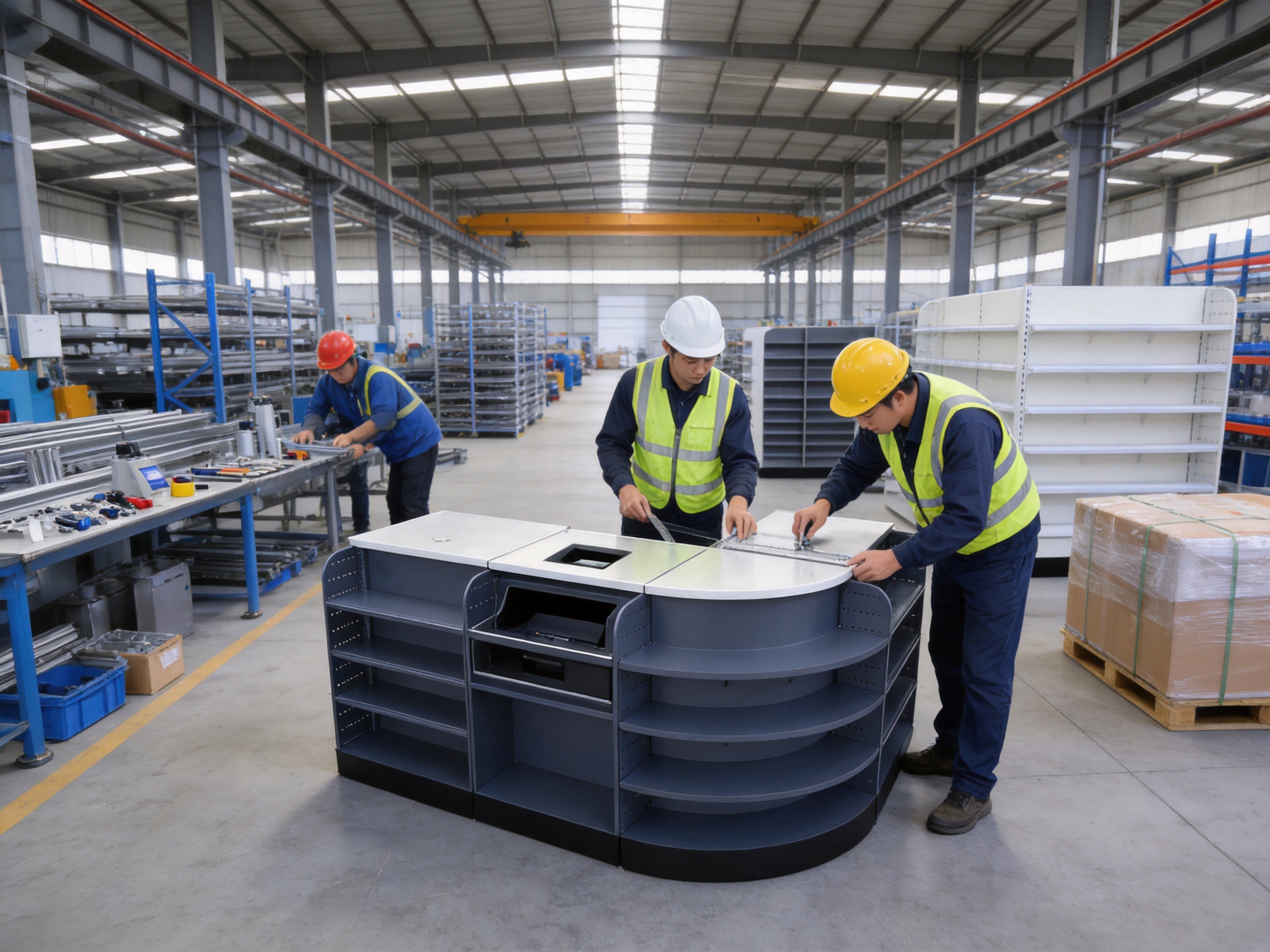
The performance of a retail checkout counter depends not only on its visible design but also on the manufacturing process behind it. Consistent material preparation, accurate fabrication, controlled assembly, and careful inspection all contribute to product reliability.
Shanghai King Global Shelf Co., Ltd. operates as a professional manufacturer specializing in shelving and storage products. Its capabilities cover product development, production, quality control, and market service. This integrated system supports the manufacturing of standard retail fixtures as well as customized storage and display solutions.
The company operates a 60,000-square-meter production base and has more than 300 employees. These resources provide a foundation for handling different product categories, production schedules, and customer requirements. The company’s product range includes warehouse racks, pallet racking, mezzanine racking, cantilever racks, supermarket shelves, office shelves, home storage shelves, and checkout counters.
8.1 Integrated Product Development
An integrated product development process allows design and manufacturing considerations to be evaluated together. This is important for checkout counters because appearance, stability, equipment placement, assembly, transportation, and cleaning must all be considered at the same time.
During development, a manufacturer can review whether the frame supports the intended loads, whether the countertop is suitable for daily use, whether equipment can be positioned correctly, and whether the final product can be produced consistently. This approach is more reliable than treating design as an isolated visual exercise.
8.2 Production Consistency
Retail projects often require multiple units with matching dimensions and appearance. Consistent production is especially important for chain stores, distributors, and large commercial installations. Differences between units can create difficulties during installation and lead to an inconsistent store image.
A structured manufacturing system helps control repeated production steps. These may include material preparation, component fabrication, surface treatment, assembly, inspection, and packaging. The exact process can vary according to material selection and product configuration, but the goal remains the same: to deliver stable and repeatable products.
8.3 Quality Control
Quality control should cover more than visual appearance. For a checkout counter, important inspection considerations may include dimensional accuracy, frame stability, surface condition, drawer operation, component fit, edge treatment, assembly quality, and packaging protection.
Quality checks are particularly important for customized products because the risk of specification errors can increase when dimensions or configurations differ from standard models. Clear technical drawings, confirmed samples, and documented production requirements can help reduce these risks.
8.4 International Market Experience
The company exports its products to North America, Southeast Asia, Japan, South Korea, the Middle East, Europe, and other regions. International supply experience requires attention to different customer expectations, packaging practices, project specifications, communication requirements, and logistics conditions.
For overseas buyers, a manufacturer’s ability to communicate clearly and manage production details can be as important as the product itself. A coordinated process from inquiry to design confirmation, production, inspection, and shipment can help buyers manage project schedules more effectively.
9. How the Product Supports Different Retail Applications
9.1 Supermarkets
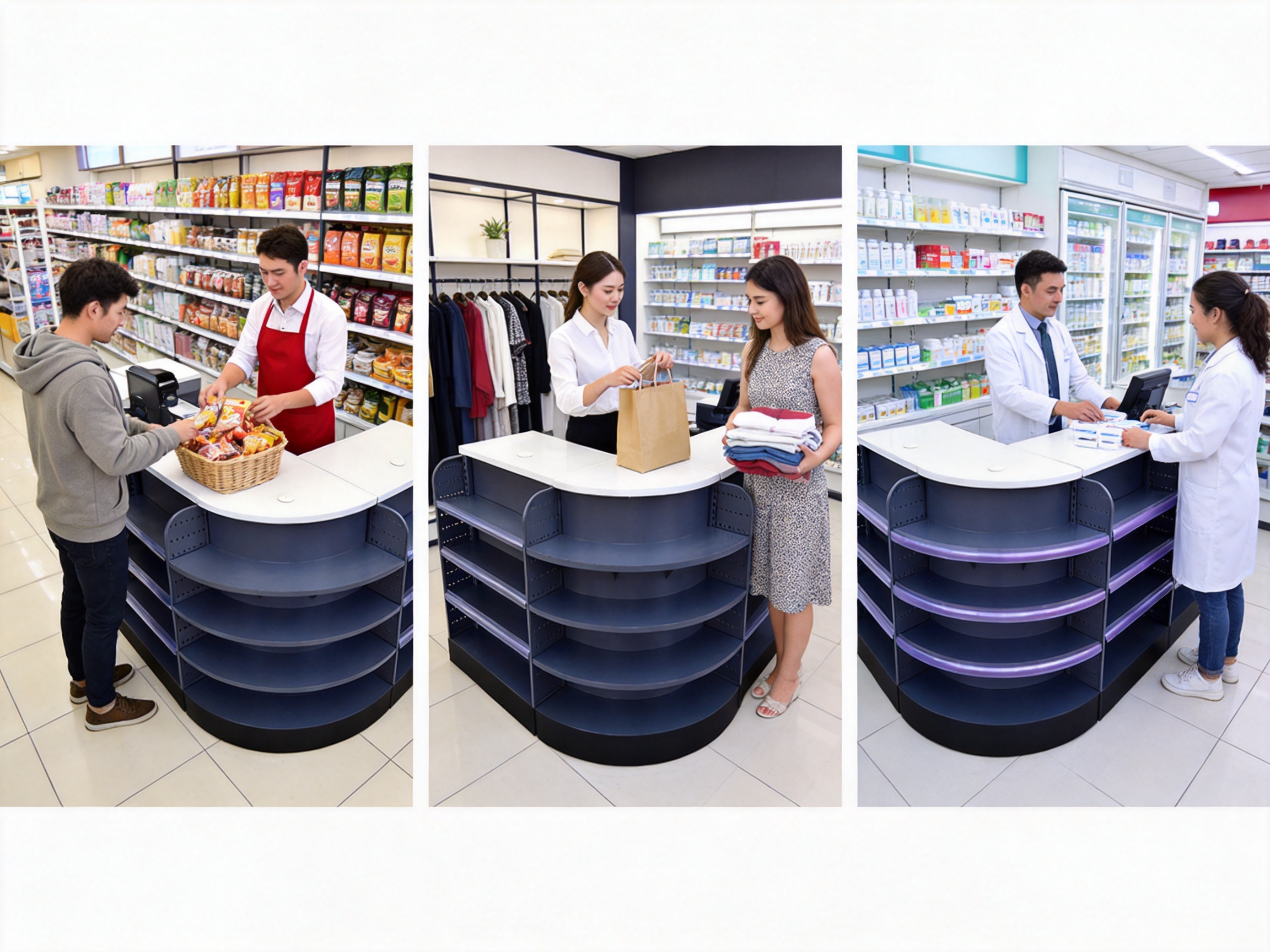
Supermarkets typically process a high volume of transactions and require checkout furniture that can withstand frequent use. The counter can support scanner placement, cash handling, product movement, and a clearly defined customer-facing area.
In a supermarket project, the counter may be installed as a single service point or as part of a larger checkout line. Its compact design can help preserve space for queues and adjacent merchandise. Multiple units can also be planned with consistent dimensions and appearance.
9.2 Convenience Stores
Convenience stores often operate in compact locations and need to maximize every section of the sales floor. The checkout counter can combine payment operations with a small, efficient workstation that does not obstruct customer movement.
Because convenience stores may sell a mixture of packaged foods, drinks, household items, and quick-service products, a stable and easy-clean countertop is valuable. The integrated cash drawer and scanner space can also help reduce equipment clutter.
9.3 Clothing Boutiques
In a clothing boutique, the checkout counter may be used for payment, customer service, gift wrapping, order collection, and returns. A professional counter can support these activities while complementing the store’s visual identity.
Custom dimensions and finishes may be considered for boutiques with distinctive interior designs. The counter can be positioned near the entrance, fitting room area, or exit depending on the customer journey and staff responsibilities.
9.4 Pharmacies and Specialty Shops
Pharmacies and specialty shops often require a clear and organized service point. Customers may need to ask questions, present products, confirm purchases, and complete payments in a controlled area.
The sturdy structure and easy-clean surfaces support regular use, while the organized layout helps staff manage equipment and customer interactions. The appropriate configuration should be selected according to the store’s service process and equipment requirements.
9.5 Gift Shops and Trade Shows
Gift shops and temporary trade-show environments may need compact counters that are easy to integrate into changing layouts. A dedicated checkout desk provides a more professional transaction point than a temporary table and can help create a consistent brand presentation.
For temporary projects, retailers and exhibitors should consider transportation, assembly, storage between events, and the available electrical supply. Customization may help the counter fit a particular booth or promotional area.
10. Installation and Store Planning Recommendations
Successful use of a checkout counter begins with proper planning. Before ordering or installing the unit, the retailer should examine the store’s traffic flow and determine how customers will approach, queue, pay, and leave the checkout area.
The counter should not create a bottleneck near the entrance or block emergency routes, storage access, fire equipment, or essential service areas. Adequate space should be left for employees to work comfortably and for customers to move around the counter without contact or confusion.
10.1 Equipment Compatibility
Retailers should measure the scanner, cash drawer, payment terminal, monitor, printer, and other equipment before finalizing the counter specification. Equipment should be positioned so that employees can operate it without excessive reaching or twisting.
Cable routing should also be considered. Loose cables can create a trip hazard, collect dust, or make cleaning difficult. When possible, the installation plan should identify cable entry points and power access before the counter is delivered.
10.2 Customer and Staff Ergonomics
The height and depth of the workstation influence cashier comfort and customer interaction. A counter that is too high, too low, too deep, or too narrow may make daily work less comfortable. The preferred dimensions should be evaluated according to the employees who will use the station and the products that will pass across it.
For stores with long operating hours, ergonomic planning is particularly important. A comfortable workstation can support more consistent employee performance and reduce unnecessary physical strain over time.
10.3 Delivery and Assembly
Before delivery, the retailer should confirm door widths, elevator capacity, stair access, loading areas, and the route from the receiving point to the final installation location. Large retail furniture can be difficult to move if these details are overlooked.
Packaging should protect the countertop, frame, drawer components, and surface finish during transportation. After delivery, the counter should be checked for visible damage and assembled according to the approved instructions. Any discrepancies should be recorded before the unit is placed into operation.
11. Cleaning, Maintenance, and Long-Term Use
Regular maintenance helps preserve the appearance and functionality of a checkout counter. Daily cleaning should remove dust, packaging residue, fingerprints, and spills from the countertop and accessible surfaces. Store employees should use cleaning materials appropriate for the surface finish and avoid harsh products that could cause damage.
The cash drawer should be checked periodically for smooth opening and closing. Scanner spaces and equipment areas should remain free of unnecessary items. If a device is moved or replaced, the retailer should confirm that the new equipment fits securely and does not interfere with the cashier’s workflow.
Fasteners, fittings, and structural connections can be inspected as part of a regular maintenance schedule. If the counter is relocated, it should be checked again for stability after installation. Any damaged component should be repaired or replaced rather than ignored.
11.1 Maintaining a Professional Appearance
The checkout station is highly visible, so appearance maintenance is important. Store teams should avoid allowing cartons, personal belongings, unused equipment, and excess packaging to accumulate on or around the counter.
A clean and organized workstation makes transactions easier for employees and creates a better impression for customers. It also improves access to equipment and simplifies routine cleaning.
12. Why Choose an Experienced Storage and Retail Fixture Manufacturer?
Checkout counters are part of a larger retail environment that may include supermarket shelves, warehouse racks, display fixtures, office storage, and home organization products. Working with a manufacturer experienced in multiple storage categories can provide a broader perspective on space planning and product integration.
Shanghai King Global Shelf Co., Ltd. has specialized in shelving and storage products since 2010. Its experience includes solutions for supermarkets, warehouses, offices, homes, and other commercial environments. This broad product knowledge can be valuable for retailers seeking coordinated fixtures rather than a single isolated product.
The company’s integrated capabilities cover design, development, production, quality control, and customer service. Its production base, technical team, and manufacturing processes support standard products and customized OEM/ODM projects. For a retailer, this means that product discussions can address practical issues such as dimensions, storage capacity, store layout, manufacturing feasibility, and delivery requirements within one coordinated process.
12.1 A Partner for Customized Projects
Retail projects frequently involve special requirements. A store may need a non-standard counter length, a particular height, additional equipment openings, a matching shelf system, or a coordinated color and finish. An experienced manufacturer can evaluate these requirements and help convert them into a workable specification.
Customization should always be based on clear technical communication. Buyers should provide drawings, measurements, photos, equipment information, expected quantities, and intended applications. The manufacturer can then review the request, recommend a suitable structure, and confirm the details before production.
12.2 Supporting Global Customers
International buyers may require assistance with product specifications, packaging, shipping preparation, documentation, and installation planning. A manufacturer with export experience is better positioned to understand the importance of these supporting tasks.
For distributors and project contractors, reliable communication can help reduce misunderstandings and improve order coordination. For retailers opening new locations, a consistent supplier can help standardize checkout counters and related storage products across different markets.
13. Selecting the Right Checkout Counter Configuration
The correct checkout counter configuration depends on the store’s transaction volume, available space, equipment, product types, staffing model, and customer-flow requirements. A small boutique may need a compact customer-service counter, while a supermarket may require a longer unit with dedicated scanning and bagging areas.
Before purchasing, retailers should define the primary purpose of the counter. Is it mainly for payment processing, or will it also support returns, product pickup, gift wrapping, customer service, and inventory-related work? The answer will influence the required countertop area and storage configuration.
13.1 Questions for Retail Planning
Retailers should consider how many employees will use the workstation, how many transactions are expected during peak periods, and whether customers will queue in front of or beside the counter. They should also identify the location of payment equipment, receipt printers, scanners, computers, and power supplies.
Other considerations include the direction in which products move across the counter, the location of shopping bags, the placement of promotional items, the visibility of the cashier, and the relationship between the checkout point and the store entrance or exit.
13.2 Balancing Compactness and Functionality
A smaller counter may preserve more floor space, but it must still provide enough room for equipment and product handling. An oversized counter may offer extra surface area but reduce customer circulation or merchandise capacity.
The ideal design balances the available space with the actual workflow. Customizable sizing can help retailers avoid choosing between a counter that is too large and one that is too limited. The best result is a workstation that supports the store’s daily operations without adding unnecessary furniture or unused surface area.
14. Practical Competitive Advantages
The product’s competitive value is based on the combination of functions rather than on a single feature. A counter that is merely attractive may not perform well in a busy store, while a highly durable unit that is difficult to clean or poorly arranged may reduce efficiency.
This checkout counter combines several practical advantages: a sturdy structure, integrated cash drawer and scanner space, an anti-slip countertop, compact dimensions, customizable sizing, and easy cleaning. Together, these features create a more complete solution for retail checkout operations.
Compared with ordinary furniture, the counter is more closely aligned with the requirements of transaction processing. Compared with a collection of separate units, it can provide a more coordinated appearance and more efficient use of space. Compared with highly complex custom installations, it may offer a simpler and more accessible solution for small and medium-sized businesses.
The manufacturing support behind the product adds another competitive advantage. A company with product development, production, quality control, and international service capabilities can support customers beyond the initial sale. This is especially valuable for customized projects, multiple-store rollouts, and buyers seeking related shelving or storage products from one source.
15. Frequently Asked Questions
Q1: What type of stores can use this checkout counter?
The counter is suitable for supermarkets, convenience stores, boutiques, pharmacies, gift shops, specialty retailers, trade-show booths, and other commercial environments that require a dedicated transaction station.
Q2: Is the counter suitable for small stores?
Yes. Its compact design is intended to help small and medium-sized retailers save floor space while maintaining essential checkout functions. The counter can be planned according to the available store area and customer circulation requirements.
Q3: Does the product include a cash drawer?
The design includes built-in cash drawer space. The final equipment configuration should be confirmed according to the retailer’s selected cash drawer, point-of-sale system, and project requirements.
Q4: Is there space for a barcode scanner?
Yes. The product includes dedicated scanner space. Retailers should provide scanner dimensions and installation preferences when confirming a standard or customized configuration.
Q5: Can the counter dimensions be customized?
Yes. Customizable sizing is available for store layouts with specific width, depth, height, equipment, or space requirements. Buyers should provide accurate measurements and project drawings whenever possible.
Q6: What are the advantages of an anti-slip countertop?
An anti-slip countertop helps products remain more stable during scanning and payment. It supports organized merchandise handling and can reduce unnecessary movement across the working surface.
Q7: Is the counter easy to clean?
Yes. The product is designed with easy-clean surfaces that support regular retail maintenance. Cleaning methods should be selected according to the surface finish and the manufacturer’s care recommendations.
Q8: Can this counter be used with modern point-of-sale equipment?
It can be planned for use with common retail equipment such as scanners, cash drawers, payment terminals, monitors, and receipt printers. Equipment dimensions, cable requirements, and placement should be confirmed before production or installation.
Q9: Does the manufacturer provide OEM and ODM services?
Shanghai King Global Shelf Co., Ltd. provides standard products as well as customized OEM and ODM solutions. The exact customization scope depends on the technical requirements, order quantity, production feasibility, and approved specifications.
Q10: Can the counter be combined with other retail fixtures?
Yes. It can be incorporated into a broader retail project involving supermarket shelves, storage racks, display fixtures, warehouse systems, and other space-utilization products. Coordinating these fixtures can help create a more consistent store layout.
Q11: What information should a buyer provide for a quotation?
A buyer should provide the required quantity, counter dimensions, store layout, equipment specifications, preferred materials or finishes, delivery destination, packaging requirements, and any branding or customization requirements.
Q12: What makes this product different from an ordinary desk?
This product is developed specifically for retail checkout operations. It includes integrated cash drawer and scanner space, an anti-slip countertop, a sturdy commercial structure, compact planning, and customization options that are generally not available in an ordinary office desk.
16. Conclusion
The Retail Supermarket Cashier Checkout Counter Desk is a practical solution for retailers seeking a more efficient, organized, and professional checkout area. Its integrated design brings together the main requirements of a retail workstation, including stable construction, cash drawer space, scanner accommodation, anti-slip product placement, compact dimensions, customizable sizing, and easy maintenance.
For small and medium-sized stores, the counter can help preserve valuable floor space while improving the customer experience. For larger retail projects, multiple units can be considered as part of a coordinated checkout layout. Its application across supermarkets, convenience stores, boutiques, pharmacies, gift shops, and trade-show environments demonstrates its versatility.
The product is supported by Shanghai King Global Shelf Co., Ltd.’s experience in shelving, storage, display, and customized retail manufacturing. With an integrated system covering product development, manufacturing, quality control, and market service, the company can support both standard orders and OEM/ODM projects. Its 60,000-square-meter production base, team of more than 300 employees, international export experience, and broad product portfolio provide a strong foundation for retail fixture projects.
A successful checkout station should make transactions easier for employees, clearer for customers, safer for cash handling, and more efficient for the store as a whole. By combining these goals in one coordinated product, this checkout counter offers a dependable foundation for modern retail operations and customized store development.
References
1. Retail Store Planning Principles: Customer Flow, Service Areas, and Space Utilization.
2. Commercial Furniture Maintenance Guidelines for High-Contact Retail Environments.
3. Point-of-Sale Workstation Design: Equipment Placement, Employee Workflow, and Customer Interaction.
4. Principles of Warehouse, Supermarket, and Commercial Storage Fixture Manufacturing.
5. International Retail Fixture Manufacturing and OEM/ODM Project Management Practices.
6. General Workplace Ergonomics for Cashier Stations and Customer-Service Counters.
7. Quality Control Considerations for Metal Shelving, Retail Fixtures, and Customized Storage Products.


 English
 Español
 русский
 Français
 한국어
 عربى
 ไทย
 Deutsch
 Bahasa Melayu
 Português
 Polskie